Why 97% of Website Visitors Leave Without Talking to Sales (And How to Fix It)
Most B2B websites convert less than 3% of visitors into pipeline. Here's why website visitors leave without engaging, and the proven strategies to fix your inbound conversion problem.
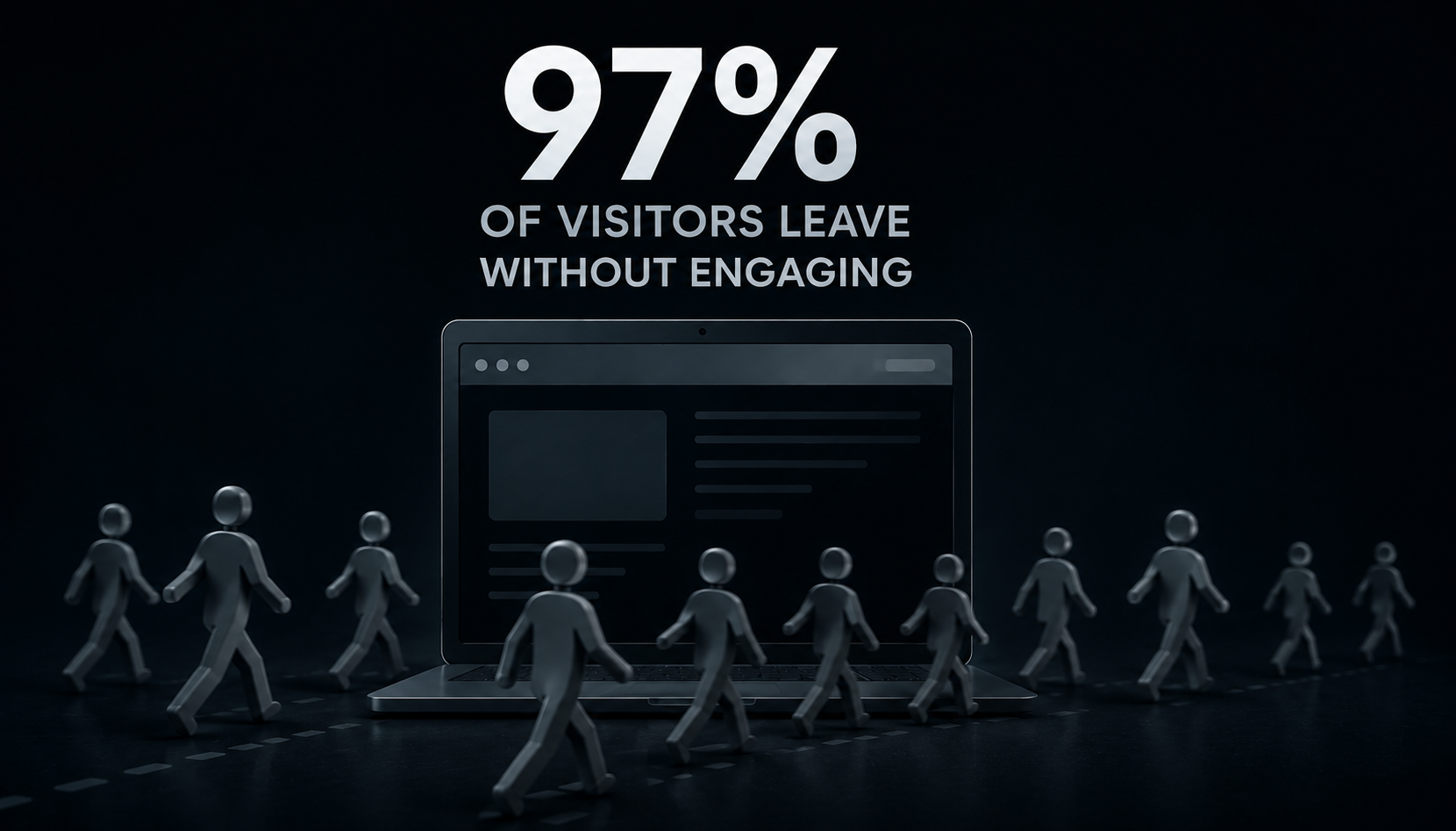
You drove 10,000 visitors to your website last month.
You spent money on ads. You invested in SEO. Your content team shipped three blog posts. Your demand gen campaigns ran across LinkedIn and Google.
9,700 of those visitors left without saying a word.
No form fill. No chat message. No demo request. No phone call. Just a bounce.
That's not a traffic problem. That's a conversion problem -and it's the most expensive silent failure in B2B revenue.
According to research from Marketo and SiriusDecisions, 97% of B2B website visitors leave without converting. The vast majority never return. The pipeline they represented evaporates quietly, while marketing and sales teams keep debating ad spend and content calendars as if traffic volume is the variable that matters.
It isn't.
This guide explains exactly why website visitors leave without engaging with sales, what the data says about the window you have to capture them, and what the fastest-growing B2B teams are doing to convert traffic into pipeline in real time.
The Real Reason Website Visitors Don't Convert
Reason 1: The Website Doesn't Sell -It Describes
Most B2B websites were built to inform, not to sell. They present features, publish case studies, explain pricing tiers, and offer a "Book a Demo" button buried beneath the fold.
But visitors don't behave like readers. They're evaluating. They want to know: Is this for a company like mine? Can it solve my specific problem? What does it actually look like in use?
A page with paragraphs and screenshots cannot answer those questions the way a conversation can. The cognitive gap between "browsing a website" and "understanding whether this product is right for me" is enormous -and most B2B websites do nothing to close it.
The self-contained answer: A B2B website that functions as a passive brochure instead of an active sales channel will lose 97% of its visitors before any conversation starts. High-intent buyers need to ask questions, see the product in action, and get objections handled in real time -not after submitting a form and waiting 42 hours.
Reason 2: Speed to Lead Has Collapsed -and Nobody Noticed
Speed to lead is the time elapsed between a prospect showing intent and a sales rep responding. According to Harvard Business Review research, companies that respond to inbound leads within one hour are 7x more likely to qualify that lead than companies that respond after two hours. Companies that wait 24 hours are 60x less likely to qualify than those responding in the first hour.
The average B2B company takes 42 hours to respond to a form submission.
This isn't a staffing problem, though it feels like one. It's an architectural problem. The standard inbound conversion flow -visitor fills form → marketing ops receives lead → SDR is assigned → SDR sends email → prospect responds -introduces compounding delays at every handoff. By the time a human reaches out, the buyer's intent has cooled. They've evaluated two competitors. Some have already bought.
The speed-to-lead window is narrowest on the website itself, during the visit. This is the moment when buyer intent is at its absolute peak -they're on your pricing page, they read the case study, they searched your brand name. Every minute after they leave your site is a minute of decaying intent.
Reason 3: Forms Create Friction Where There Should Be Conversation
The "Book a Demo" form problem: Forms ask buyers to do the work. Fill in your name, company, role, team size, what problem you're trying to solve -all before receiving any value in return. According to Formstack's State of Forms research, 67% of visitors abandon forms when they encounter unexpected questions or length.
For high-intent prospects, a form is the worst moment to add friction. You caught someone who was ready to talk. Your response was: fill this out and we'll get back to you in a few days.
This is the equivalent of a salesperson at a conference booth handing a prospect a clipboard and walking away.
Forms convert a fraction of visitors because they're designed around the seller's data collection needs, not the buyer's purchase journey. They signal that the company isn't available -only its database is.
Reason 4: Text Chatbots Aren't Working
Marketers added chatbots to solve the 97% problem. Most chatbots made it worse.
The numbers tell the story: average chatbot engagement rates across B2B websites hover between 2–4% of visitors, according to Drift's own benchmark data. Of those who start a chat conversation, a large majority abandon it before reaching a human or completing a qualifying exchange.
Text chatbots fail for predictable reasons:
They follow scripted flows that break the moment a visitor asks something unexpected
They cannot show the product, present a deck, or demonstrate value
They redirect objections to help articles instead of answering them
The text-only format feels robotic and low-effort -visitors recognize it as a widget, not a conversation
For complex B2B products, they cannot capture or communicate the information buyers actually need
The result: companies invested in chatbot technology, watched engagement metrics disappoint quarter after quarter, and concluded that "website engagement can't be automated." That conclusion is wrong. The technology they tried was wrong.
Reason 5: After-Hours Traffic Goes Completely Unserved
B2B buying behavior doesn't operate on a 9-to-5 schedule. Research from Salesforce shows that 40% of B2B research and purchase decisions happen outside business hours -evenings, weekends, and across global time zones.
A prospect in Singapore evaluating your product at 9 PM their time has no one to talk to. A VP of Sales in London who finally has 30 minutes to review solutions on a Saturday morning fills out a form and waits until Tuesday to hear back. By then, she's made a different decision.
Companies that rely on human SDRs for inbound coverage are, structurally, losing almost half their high-intent traffic with no possibility of recovery.
What Actually Works: The Four Components of Real-Time Inbound Conversion
Component 1: Immediate Engagement at Peak Intent
The visitor is on your site right now. That is the only moment when zero friction exists between their intent and your conversion. Any system that waits -a form, an email sequence, a scheduled SDR call -adds delay and loses intent.
The highest-converting inbound motion engages the visitor the moment they arrive, during the visit, without any required action from the prospect. Not "click here to chat." Just: a conversation starts.
Component 2: Face-to-Face Presence, Not Text
There's a reason your best sales reps close 40–50% of the deals they touch while your website closes 0%. The rep is present. They read body language, respond to hesitation, demonstrate enthusiasm, and adapt in real time. The website cannot do any of those things.
Face-to-face communication outperforms text in measurable ways. Research from the Wharton School shows that requests made in person are 34 times more successful than those made via text or email. The presence of a human-like face creates trust signals that text interfaces cannot generate.
Until recently, face-to-face presence on a website wasn't possible at scale. It is now.
Component 3: Product Demonstration Without Scheduling Friction
The highest barrier between a visitor's intent and a purchasing decision is not price -it's uncertainty. "Does this product actually work the way they say it does?" "Can it handle my specific use case?" "What does it look like in practice?"
Every day a prospect waits for a scheduled demo is a day that uncertainty stays unresolved. Competitive products get evaluated. Internal priorities shift. The deal cools.
The fastest-converting companies eliminate this gap by enabling instant product demonstrations -the visitor sees the product in action during the visit, before they leave.
Component 4: Qualification That Captures Intent, Not Just Data
Traditional lead capture collects fields: name, email, company, role. This satisfies CRM requirements but tells sales almost nothing about buying readiness.
The most valuable qualification data is behavioral and conversational: What problem are they actively trying to solve? What's their timeline? Have they evaluated competitors? What's blocking a decision? What does their budget conversation look like?
This data cannot be captured in a form. It emerges through conversation -and it's the information that determines whether a lead is worth a senior AE's time or needs to be nurtured.
How AI SDRs Are Solving the 97% Problem
What Is an AI SDR for Inbound?
An AI SDR for inbound is a software agent deployed on a B2B website that engages visitors in real-time, qualifies them through natural conversation, handles objections, demonstrates the product, and books meetings automatically -without requiring a human SDR to be available. Unlike text chatbots, advanced AI SDRs operate with the conversational depth, product knowledge, and objection-handling capability of a trained sales rep.
AI SDR platforms purpose-built for inbound conversion represent a category that didn't exist five years ago. Today, they're closing the gap between the 97% who leave and the 3% who convert.
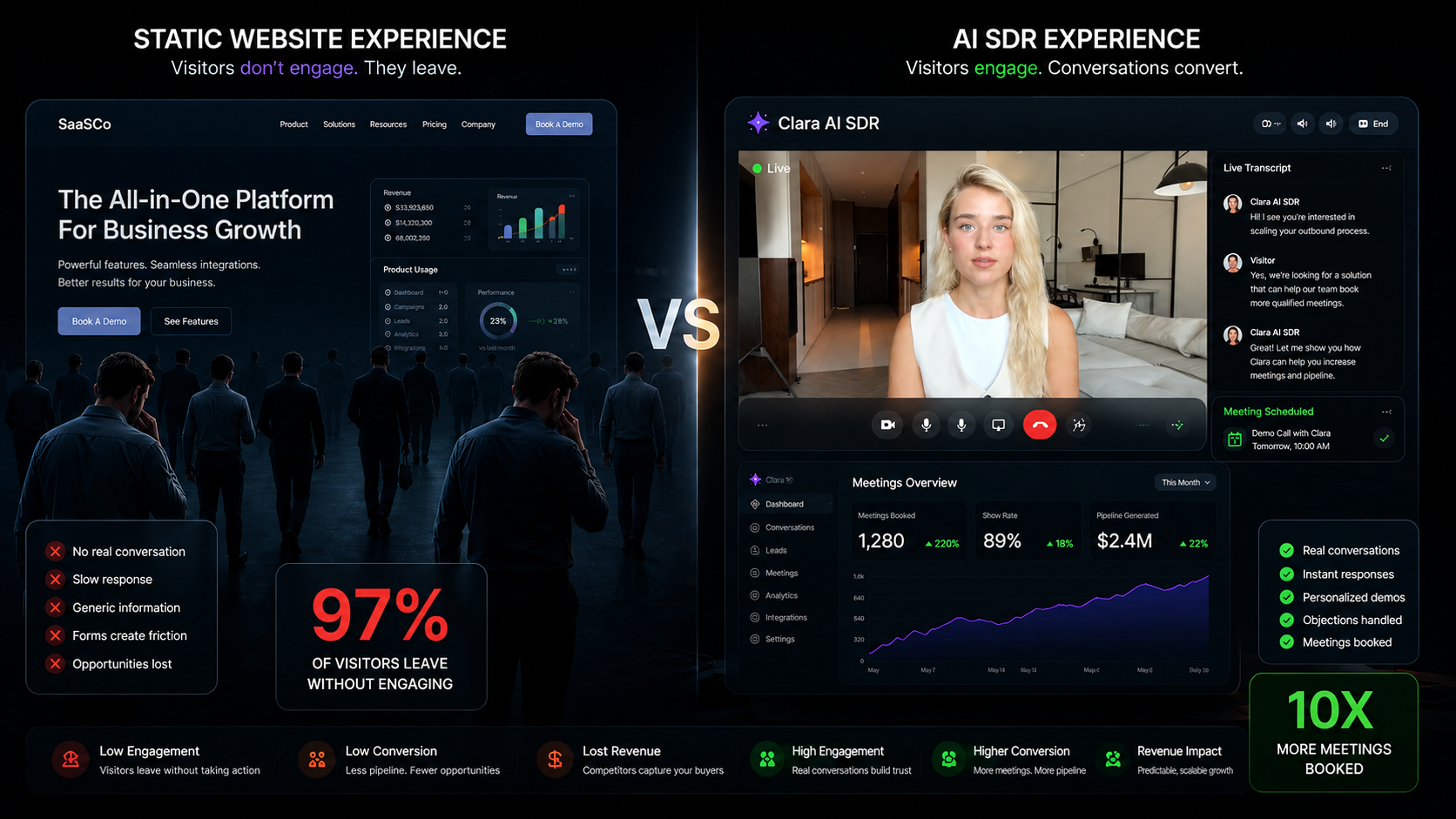
Clara AI SDR: Inbound Conversion with Face-to-Face AI
Clara by TruGen.ai is an AI SDR teammate that lives on your website and engages visitors face to face -not through a text chat widget. Clara appears as a lifelike AI sales representative who can speak directly with visitors, run live product demos, share her screen to present decks and case studies, open a live browser to navigate pricing pages and integration documentation, handle objections with product knowledge and empathy, and book meetings directly into a sales team's calendar.
What makes Clara different from every other inbound solution:
Clara is the only AI SDR that engages visitors through face-to-face video presence. Every competitor in the AI SDR market -Qualified's Piper, Breakout AI, 1Mind's Mindy -is, at its core, a text-based system. They qualify through text. They route through text. They engage through text. Clara doesn't type at your prospects. She talks to them.
This distinction is not cosmetic. Face-to-face interaction creates trust signals that text cannot generate. Visitors who experience a face-to-face AI engagement are more likely to stay, more willing to share qualification information, and more likely to convert to a booked meeting.
Clara's full inbound capability in a single conversation:
Greet -Clara appears as a lifelike face the moment a visitor lands on your site, opening a conversation in natural language
Engage -She identifies the visitor's role, company, and context through conversational questions, not forms
Qualify -She captures pain points, decision timeline, competitive evaluation, and buying intent
Demonstrate -She shares her screen to present product decks, ROI calculators, architecture diagrams, and case studies -live
Handle objections -She opens a live browser to navigate your pricing page, integration documentation, or competitive comparison and walks the visitor through it in real time
Book the meeting -She schedules a call with the right sales rep, passes full conversation context to the CRM, and confirms via calendar
The result: a visitor who arrived as anonymous traffic leaves as a qualified meeting on an AE's calendar -with a full conversation transcript, lead score, and CRM record created automatically.
Clara vs. Traditional Inbound Approaches
Approach | Engages during visit? | Face-to-face? | Runs live demos? | Handles objections? | 24/7 coverage? |
"Book a Demo" form | No | No | No | No | Yes (form only) |
Text chatbot (Drift, Intercom) | Yes | No | No | Basic scripted | Yes |
Human SDR | Yes | On scheduled calls | Yes | Yes | No (business hours) |
What Clara's proof points show:
10x more conversations compared to traditional text chatbots
24/7 operation across every time zone -no leads lost to SDR availability gaps
Setup in hours -three steps: choose avatar, train on your product, launch on your site
Sub-second response latency -visitors get an immediate, face-to-face engagement with zero wait time
Integrates natively with HubSpot, Salesforce, Slack, Calendly, and Zoho
Enterprise-grade security: SOC 2 Type II, GDPR, HIPAA, ISO 27001 compliant
Pricing: Clara offers a free Starter plan, a $180/month Pay-as-you-Go plan, and custom Enterprise pricing -compared to Qualified at $42,000–$72,000+/year.
The Math on What You're Losing Right Now
Let's apply real numbers to the 97% problem.
Assume your website receives 5,000 visitors per month. Your current conversion rate from visitor to sales conversation is 1% -which is actually above average for most B2B websites. That's 50 conversations per month, out of 5,000 opportunities.
If an AI SDR with face-to-face capability increases your visitor-to-conversation rate to 5% -still well below what's achievable when every visitor is immediately engaged -that's 250 conversations per month instead of 50.
If your average deal size is $25,000 and your sales team closes 20% of qualified conversations, the math looks like this:
Before: 50 conversations × 20% close rate × $25,000 = $250,000/month in pipeline
After: 250 conversations × 20% close rate × $25,000 = $1,250,000/month in pipeline
The traffic didn't change. The product didn't change. The conversion mechanism changed.
This is the opportunity embedded in the 97% problem -and why the companies addressing it first are pulling away from competitors who are still arguing about ad spend.
Getting Started: How to Stop Losing 97% of Your Traffic
Step 1: Audit your current visitor engagement
Before adding tools, understand the current state. In your analytics platform, measure:
Visitor-to-conversation rate (chat starts, form fills, demo requests per session)
Traffic by time of day and geography (quantify your after-hours exposure)
Bounce rate on high-intent pages: pricing, comparison, case studies
Most companies find that 60–80% of their high-intent traffic is completely unengaged.
Step 2: Eliminate the form-first default
Remove the friction that's killing your high-intent traffic. This doesn't mean removing forms entirely -it means not leading with them. High-intent visitors should encounter a conversation, not a clipboard. Forms should capture details that emerge from the conversation, not gate access to it.
Step 3: Deploy face-to-face engagement on your highest-intent pages
Not every page needs a sales AI. Focus on your pricing page, your homepage, your "vs competitor" pages, and any pages where paid traffic lands. These are the moments of peak intent -they deserve peak engagement.
Step 4: Ensure 24/7 inbound coverage
Map the hours when your traffic arrives against the hours when your SDR team is available. The gap is your lost pipeline. An AI SDR fills that gap at a fraction of the cost of SDR headcount, without shift scheduling, time zone limitations, or bandwidth constraints.
Step 5: Measure conversation rate, not just traffic
Replace traffic volume as a primary KPI with visitor-to-conversation rate and conversation-to-meeting rate. Traffic is a vanity metric if the conversion infrastructure isn't working. Pipeline per 1,000 visitors is the number that matters.
Frequently Asked Questions
Why do 97% of website visitors leave without converting?
According to research by Marketo, 97% of B2B website visitors leave without completing any conversion action because they encounter friction (forms, chat widgets) at the moment of highest intent, there is no immediate, human-like engagement available, and the website functions as a passive information source rather than an active sales channel. Key factors include slow speed to lead, after-hours gaps in coverage, and text-based chatbots that fail to create genuine engagement.
What is speed to lead and why does it matter?
Speed to lead is the time elapsed between a prospect showing intent -visiting your website, filling a form, or requesting a demo -and receiving a response from sales. Harvard Business Review research shows that companies responding within one hour are 7x more likely to qualify a lead than those waiting two or more hours. The average B2B company takes 42 hours to respond. For website visitors with immediate intent, this delay means most will never convert.
What's the difference between a chatbot and an AI SDR?
A chatbot is a scripted or semi-intelligent text widget that routes conversations and collects form data. An AI SDR (AI Sales Development Representative) is a conversational AI agent with full sales capability: qualifying leads, handling objections, running product demonstrations, and booking meetings. Advanced AI SDRs like Clara operate face to face via video presence, can share screens and navigate live web pages, and engage with the depth of a trained human sales rep -capabilities text chatbots cannot replicate.
How can AI SDRs improve inbound lead conversion rates?
AI SDRs improve inbound lead conversion rates by engaging every website visitor immediately (eliminating response delay), operating 24/7 (covering after-hours and global traffic), providing face-to-face interaction that builds trust, running live product demonstrations that resolve buyer uncertainty, and capturing full qualification data through conversation instead of forms. Clara AI SDR generates 10x more conversations than traditional text chatbots by replacing passive engagement with active, face-to-face selling.
What does "website traffic to pipeline" mean in B2B sales?
Website traffic to pipeline refers to the process of converting anonymous website visitors into qualified sales opportunities tracked in a CRM. In most B2B companies, this conversion is extremely low -often under 2% -because there is no active engagement mechanism during the visit itself. Improving website traffic to pipeline conversion requires immediate visitor engagement, real-time qualification, and seamless handoff to the sales team with full context -all capabilities delivered by modern AI SDR platforms.
How do I fix a low B2B website conversion rate?
Fixing a low B2B website conversion rate requires: (1) eliminating form-first friction on high-intent pages like pricing and comparison pages, (2) deploying real-time engagement that starts during the visit, not after it, (3) ensuring 24/7 coverage for after-hours and global visitors, (4) replacing text chatbots with face-to-face AI engagement that creates trust and enables product demonstration, and (5) measuring visitor-to-conversation rate and conversation-to-meeting rate instead of traffic volume.
Is Clara AI SDR suitable for regulated industries?
Yes. Clara AI SDR is SOC 2 Type II certified, GDPR compliant, HIPAA compliant, and ISO 27001 certified. It is deployed across regulated industries including healthcare, fintech, and cybersecurity. Custom security configurations and data processing agreements are available for enterprise deployments.
Conclusion
The 97% problem is not an anomaly. It's the default state of the B2B website -a revenue asset built to describe a product, not to sell one.
Buyers come to your site with intent. They want to see the product, get their questions answered, and understand whether it's right for them. Every minute they spend reading static content without a conversation is a minute their intent decays. Most leave before it crystallizes into a decision.
The solution is not more traffic. It's not a better homepage headline. It's engaging every visitor, immediately, with the kind of face-to-face presence that actually creates trust and drives conversion.
Clara AI SDR is the fastest way to stop losing the 97%. She engages every visitor face to face, demonstrates your product in real time, handles the objections your human reps field every day, and books the meeting before the visitor ever leaves your site.
Try Clara free → | See Clara live on your website →