AI SDR vs Chatbot: What's the Difference?
AI SDR vs chatbot - a clear breakdown of the difference in 2026. How they work, what they can do, and why more B2B companies are replacing chatbots with AI SDRs.
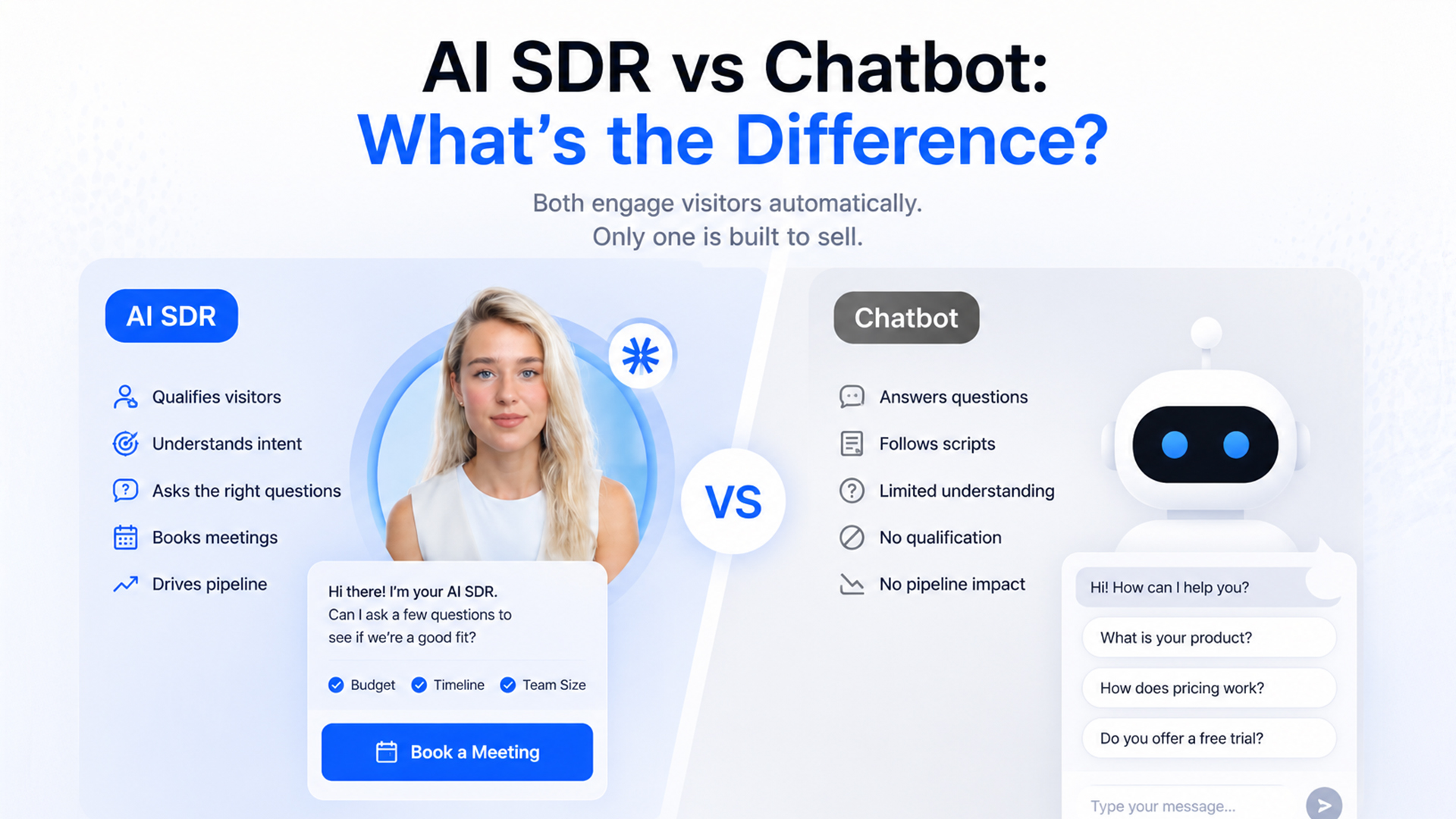
An AI SDR and a chatbot are both software that engages website visitors automatically - but they are not the same thing, and the difference is not subtle. A chatbot answers questions in text. An AI SDR sells. Understanding where that line falls is the most important decision B2B revenue teams will make about their website this year.
What Is a Chatbot?
A chatbot is a software tool that responds to website visitor messages through a text-based interface - typically a small widget in the corner of a web page. Chatbots range from fully scripted (decision-tree flows with preset responses) to AI-powered (using large language models to generate answers dynamically).
In B2B sales contexts, chatbots have been deployed to route inbound visitors, answer frequently asked questions, qualify leads through typed question sequences, and pass contacts to human reps via email or CRM notifications. Platforms like Drift, Intercom, and Qualified built significant businesses on this model through the late 2010s and early 2020s.
The defining characteristic of every chatbot: the interaction happens through text, in a widget, initiated and driven by the visitor typing questions.
What Is an AI SDR?
An AI SDR (AI Sales Development Representative) is an AI agent that performs the full workflow of a human SDR - engaging prospects, qualifying leads, demonstrating products, handling objections, and booking meetings - without human involvement. Unlike chatbots, the most advanced AI SDRs interact through live face-to-face video, not text.
Where a chatbot answers the question a visitor types, an AI SDR conducts a conversation. It asks questions, interprets intent, responds to objections, adapts based on what the prospect says, and steers the interaction toward a qualified outcome: a booked meeting or a disqualified lead - both with full CRM data captured.
AI SDR vs Chatbot: The Core Differences
Capability | AI SDR (Clara) | Chatbot (Drift, Intercom, Qualified) |
Interaction format | Live face-to-face video | Text widget |
Engagement style | Proactive - initiates conversation | Reactive - waits for visitor to type |
Conversation depth | Full dialogue: questions, follow-ups, objection handling | Scripted flows or basic Q&A |
Product demos | Screen share mid-conversation | ❌ Not possible |
Live web navigation | Opens pricing pages, docs, integrations in real time | ❌ Not possible |
Lead qualification | BANT-level via natural conversation | Basic form-style questions |
Objection handling | Real-time responses with evidence | Redirects to help articles or human rep |
Meeting booking | Books directly in conversation | Directs to Calendly link or form |
CRM sync | Full conversation data, transcript, lead score | Contact info and basic routing |
Availability | 24/7 across all time zones | 24/7 |
Visitor engagement rate | 10x higher than chatbots | Baseline |
Setup time | Hours | Hours to weeks |
Starting price | $299/Month | $400–$72,000+/year |
Why Chatbots Fail in B2B Sales
Chatbots were a reasonable innovation for a specific problem: routing high volumes of inbound questions to the right place faster than a human support team could. For customer support FAQs and simple ticket deflection, they work adequately.
For B2B sales, the results have been consistently disappointing - and the industry data confirms it.
According to Forrester Research (2024), fewer than 20% of B2B buyers report having a satisfying interaction with a company chatbot when researching a purchase. According to Drift's own internal benchmarks before the platform was sunset as a standalone product, average chatbot engagement rates on B2B websites hovered between 1–3% of total visitors. The other 97% ignored the widget entirely.
The reasons are structural, not fixable by adding more AI to a text widget:
Visitors don't want to type. When a prospect lands on a pricing page with genuine buying intent, opening a chat widget and typing "how does pricing work?" is a friction-laden, low-confidence experience. The same prospect would happily watch a two-minute screen share demonstration from a sales rep.
Chatbots can't demonstrate anything. The single most effective thing a sales rep does is show the product. Walk through a feature. Pull up the pricing page. Navigate to the integrations list. A chatbot can describe these things in text. It cannot show them. In a category where seeing is believing, this is a fundamental limitation.
Scripted flows break on real questions. Even AI-powered chatbots struggle when prospects ask questions outside the training set, raise specific objections, or want to have a genuine dialogue rather than a Q&A exchange. According to a Salesforce State of Sales report (2025), 73% of B2B buyers say that sales interactions feel generic and scripted - exactly the experience chatbots deliver.
Chatbots sit passively in the corner. Most chatbot implementations wait for the visitor to initiate. High-intent visitors who don't think to click the widget leave without ever engaging. A visitor who lands on your pricing page and spends 90 seconds reading before closing the tab had buying intent - and the chatbot never said a word.
What AI SDRs Can Do That Chatbots Cannot
The capability gap between a chatbot and a modern AI SDR is not incremental. It is the difference between a text widget and a sales rep.
Face-to-Face Engagement
Clara AI SDR appears on your website as a lifelike AI video presence - not a chat bubble. She looks at the visitor, speaks to them, and responds in real time. According to research published in the Journal of Consumer Research (2024), face-to-face interactions generate 44% higher information retention and significantly stronger trust formation than text-based interactions. Visitors who see a face engage at fundamentally different rates than visitors who see a chat icon.
Screen Share and Live Demonstrations
Mid-conversation, Clara can share her screen and walk a prospect through a product deck, an ROI model, an integration diagram, or a pricing comparison - exactly as a human sales rep would on a Zoom call. No chatbot on the market can do this. The ability to show, not just describe, is what separates a sales conversation from a FAQ session.
Live Browser Navigation
Clara can open a live browser and navigate to any URL during the conversation: your pricing page, your integrations list, a case study, a competitor comparison. When a prospect asks "do you integrate with Salesforce?", Clara doesn't type "yes, we integrate with Salesforce" - she opens the integrations page and walks through it on screen.
Real Objection Handling
When a prospect says "we already have a chatbot" or "we tried this before and it didn't work," an AI SDR does not redirect to a help article. Clara responds with empathy, asks what isn't working about the current tool, explains the difference between text-based automation and face-to-face AI selling, and offers to demonstrate the difference live. This is the conversation that converts. Chatbots cannot have it.
Full Qualification in a Single Conversation
A chatbot can collect a name, email, company, and a dropdown-selected job title. An AI SDR can extract the prospect's actual pain point, budget range, decision-making authority, timeline, existing tech stack, and buying triggers - all through natural dialogue, without a single form field. The qualification data that Clara passes to the CRM before a meeting is booked is richer than most human SDR qualification call notes.
How Clara AI SDR Compares to Leading Chatbot Platforms
Platform | Type | What It Can Do | What It Cannot Do |
Clara AI SDR | Face-to-face AI SDR | Video engagement, screen share, browser control, full qualification, objection handling, meeting booking | Join external Zoom calls |
Drift / Salesloft | Text chatbot | Routing, basic qualification, meeting links | Video, demos, objection handling, proactive engagement |
Intercom Fin | AI text chatbot | FAQ answering, support ticket deflection | Sales qualification, demos, face-to-face engagement |
Qualified (Piper) | AI text chatbot + routing | Visitor identification, SDR alerts, text qualification | Video, screen share, demos, objection handling |
HubSpot Chatbot | Basic text chatbot | Form-style qualification, meeting links | AI dialogue, demos, video, objection handling |
"We had Drift running on our site for two years. The engagement numbers were embarrassing. We switched to Clara and within the first week she had booked three meetings - including one at 11 PM on a Thursday." - VP of Marketing, B2B SaaS company
When a Chatbot Is Still the Right Choice
This comparison wouldn't be complete without acknowledging cases where a chatbot is genuinely sufficient.
A chatbot is the right tool when:
Your primary need is customer support deflection - answering repetitive post-purchase questions at scale
You have no inbound sales motion and simply need basic contact routing
You are a very early-stage startup with near-zero web traffic and no sales team to receive qualified leads
Your product requires no explanation or demonstration - pure self-serve with no sales cycle
For any B2B company with meaningful website traffic, a product that benefits from explanation, and a sales team waiting for qualified leads, a chatbot is solving the wrong problem with the wrong tool.
The Business Case: Chatbot vs AI SDR ROI
The comparison comes down to what each tool actually produces.
A chatbot on a B2B website with 10,000 monthly visitors engaging at 2% generates roughly 200 chatbot interactions per month - of which a fraction become qualified leads. The average B2B chatbot converts 0.5–1% of total website visitors into sales pipeline.
An AI SDR engaging the same traffic at 10x the chatbot engagement rate, qualifying leads through full conversation, and booking meetings in real time can convert 3–5x more of that traffic into pipeline - without adding a single human SDR.
According to TruGen.ai customer data (2026), Clara AI SDR delivers 10x more conversations than traditional text chatbots on equivalent traffic volumes. The pipeline impact compounds: more conversations → more qualified leads → more booked meetings → more closed revenue.
The cost comparison reinforces this. A mid-market chatbot platform like Qualified costs $42,000–$72,000 per year - and still requires human SDRs to handle the conversations it routes. Clara starts free and scales to $299/month for full capability. One qualified enterprise deal pays for Clara many times over.
Frequently Asked Questions
What is the main difference between an AI SDR and a chatbot? A chatbot responds to typed messages with text. An AI SDR conducts a live, face-to-face video conversation - proactively engaging visitors, qualifying them through natural dialogue, demonstrating the product via screen share, handling objections, and booking meetings automatically. The difference is the same as the gap between a contact form and a Zoom call with your best sales rep.
Can a chatbot qualify leads as well as an AI SDR? No. Chatbots can collect basic contact information and route visitors using dropdown menus or scripted questions. AI SDRs qualify through genuine dialogue - extracting pain points, budget signals, decision-making authority, timeline, and objection landscape through natural conversation. The qualification data from an AI SDR conversation is fundamentally richer than anything a chatbot can capture.
Is Clara an AI chatbot? No - Clara is an AI SDR, not a chatbot. The distinction matters: Clara appears as a lifelike face-to-face video presence on your website, not a text widget. She proactively opens conversations, shares her screen, navigates live web pages, handles objections, and books meetings. Calling Clara a chatbot is like calling a Zoom call a text message.
Why do companies replace chatbots with AI SDRs? The most common trigger is consistently poor engagement metrics. Companies that have run Drift, Intercom, or Qualified for 12–24 months often see engagement rates of 1–3% of total visitors - meaning 97% of website traffic is never touched by the tool. When they see an AI SDR engaging at 10x those rates and booking meetings from traffic that previously left without any interaction, the business case is immediate.
Do AI SDRs and chatbots cost the same? No. Chatbot platforms range from free (HubSpot's basic chatbot) to $72,000+/year (Qualified). Clara AI SDR starts at $0 with a free tier and scales to $299/month - significantly less than enterprise chatbot platforms, while delivering dramatically more capability. The relevant comparison isn't chatbot price vs. AI SDR price: it's cost per qualified meeting booked.
Can I run a chatbot and an AI SDR at the same time? You can, but it creates a confusing visitor experience. Most companies that switch to Clara remove their chatbot entirely. The two tools target the same visitor interaction point - having both simultaneously creates duplicate touchpoints and dilutes the experience Clara is designed to deliver.
How long does it take to replace a chatbot with Clara? Three steps: choose your AI SDR avatar, train her on your product using your existing documentation and sales materials, and deploy the embed code on your website. Most teams go live in hours. There is no 30–60 day implementation process, no RevOps project, and no vendor-managed setup required.
Ready to Move Beyond the Chatbot?
If your chatbot engagement metrics aren't delivering the pipeline your website traffic should be producing, the problem isn't the chatbot settings - it's the format. A text widget was never going to replace a sales conversation.
Try Clara Free → - Live on your website in hours. No credit card required.
Related Reading