How AI SDRs: Qualify Leads Automatically
Learn exactly how AI SDRs qualify leads automatically in 2026 - the signals they detect, the questions they ask, and how they route qualified leads to sales in real time.
Lead qualification is one of the most time-consuming, repetitive tasks in B2B sales. According to Salesforce's State of Sales report (2025), sales development representatives spend between 60–80% of their working hours on qualification activities - asking the same questions, scoring the same signals, and routing the same types of leads - before a single meaningful sales conversation happens.
AI SDRs are changing this. In 2026, the most advanced AI sales development representatives can qualify an inbound lead in under three minutes, capture role, company size, intent, pain point, budget range, and buying timeline through natural conversation, sync everything to the CRM, and book a meeting for the sales team - all without a human touching the process.
This guide explains exactly how they do it.
What Is Automated Lead Qualification?
Automated lead qualification is the process of using software - specifically AI - to evaluate an inbound prospect's fit, intent, and readiness to buy, without requiring a human sales rep to initiate the conversation.
Traditional qualification required a human SDR to call or email a lead, ask a series of diagnostic questions (role, company size, use case, timeline, budget), score the responses against an ideal customer profile, and decide whether to route the prospect to an Account Executive. This process took hours or days after a lead's initial interest - by which point that interest had often cooled.
AI SDRs automate this entire sequence. When a visitor arrives on a B2B website, an AI SDR can initiate a face-to-face conversation immediately, ask qualification questions naturally within the dialogue, interpret the answers in real time, and deliver a scored, context-rich lead profile to the sales team - often within the same session.
Why Manual Lead Qualification Fails at Scale
Before examining how AI SDRs qualify leads, it's worth understanding the scale of the problem they're solving.
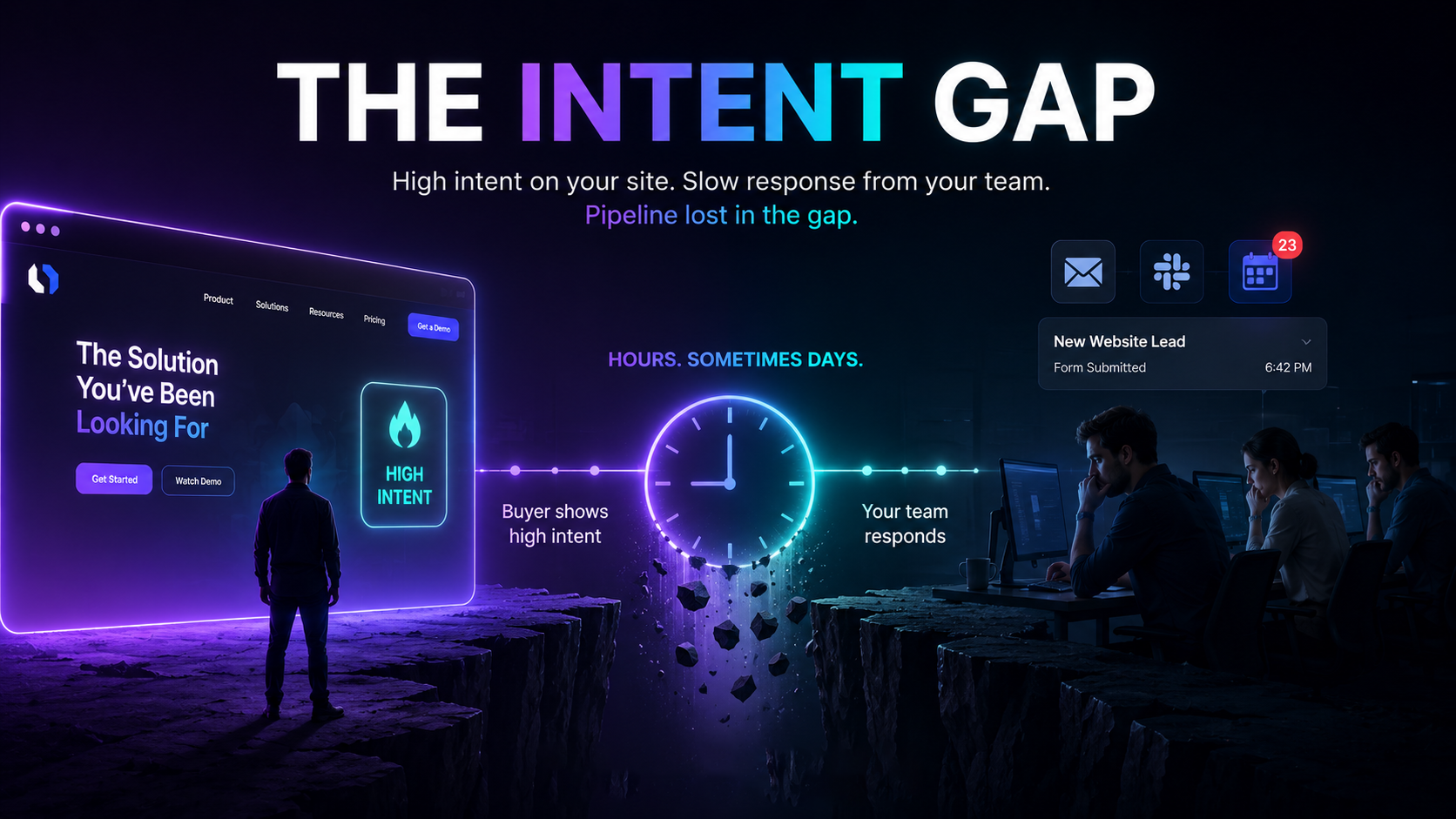
The speed problem: According to Harvard Business Review research, companies that respond to inbound leads within one hour are 7x more likely to qualify that lead than those who wait longer. Yet the average B2B company takes 42 hours to respond to a form submission (InsideSales.com, 2024). By the time a human SDR makes contact, most high-intent visitors have already evaluated three competitors.
The coverage problem: Human SDRs work business hours. B2B website traffic doesn't. According to data from Clearbit (2024), 40% of enterprise B2B web traffic arrives outside of standard working hours - evenings, early mornings, weekends, and international time zones. These visitors arrive with buying intent and leave without a single conversation.
The capacity problem: A single SDR can handle roughly 60–80 meaningful qualification conversations per week before quality degrades. High-traffic B2B websites may see thousands of potential leads per week. The math doesn't work. SDR headcount is a hard ceiling on how much inbound traffic a company can qualify.
The consistency problem: Human qualification is inconsistent. Two SDRs asking the same prospect the same questions will score the lead differently. Training, fatigue, and individual judgment all introduce variance. AI SDRs apply the same qualification criteria to every single conversation.
AI SDRs solve all four problems simultaneously.
How AI SDRs Qualify Leads: The Step-by-Step Process
Modern AI SDRs follow a structured qualification process that mirrors what a trained human SDR would do - but executes it faster, more consistently, and at unlimited scale.
Step 1: Proactive Engagement
When a visitor lands on a target page (homepage, pricing page, product page), the AI SDR initiates contact immediately. Unlike passive chatbots that wait for the visitor to click, advanced AI SDRs proactively open a conversation based on visitor behavior signals - time on page, scroll depth, return visits, referral source.
This matters for qualification because intent decays rapidly. According to InsideSales.com research, the odds of qualifying a lead drop by 80% after the first five minutes of inactivity. An AI SDR that engages the moment intent is detected operates in the optimal qualification window - every time.
Step 2: Identity and Role Discovery
The first phase of qualification establishes who the prospect is. AI SDRs ask these questions conversationally, not as a form:
What brings you to [Company] today?
What's your role on the team?
How large is your sales/marketing team?
Are you evaluating tools for yourself or for a larger team?
These responses establish persona fit against the ideal customer profile. An AI SDR trained on an ICP knows that a VP of Sales at a 200-person B2B SaaS company is a high-fit lead; a student researching for a college paper is not. Routing happens automatically based on the profile detected.
Step 3: Pain Point and Use Case Discovery
The second phase identifies why the prospect is here and what problem they're trying to solve. This is the highest-value qualification data - it tells the sales team what story to tell in the follow-up meeting.
AI SDRs use open-ended questions with dynamic follow-ups:
What's the main challenge your team is trying to solve?
How are you currently handling [identified problem]?
What's not working about your current approach?
The AI interprets these responses against trained knowledge of common pain points, objections, and buying triggers. It identifies which pain cluster the prospect belongs to - website conversion, SDR bandwidth, chatbot disappointment, after-hours coverage - and adjusts the conversation accordingly.
Step 4: Qualification Criteria Scoring (BANT + Intent)
Traditional sales qualification frameworks like BANT (Budget, Authority, Need, Timeline) are applied by AI SDRs through conversational extraction rather than explicit interrogation.
BANT Criteria | What the AI Asks | What It's Detecting |
Budget | "Are you looking to get started quickly or is this more of a longer-term evaluation?" / "What's your typical budget for tools in this category?" | Budget range and urgency |
Authority | "Are you the one driving this decision or are there others involved?" | Decision-making role and buying authority |
Need | "How significant is this problem for your team right now - is it urgent or more exploratory?" | Problem severity and active pain |
Timeline | "When were you hoping to have something in place?" | Buying window and urgency |
Beyond BANT, AI SDRs also score behavioral intent signals: which pages the visitor came from, how many times they've visited, whether they came from a high-intent search query or a direct campaign, and how deeply they've engaged with product pages versus blog content.
Step 5: Objection Handling During Qualification
Human SDRs encounter objections during qualification calls. So do AI SDRs - and handling them in real time is part of the qualification process, not separate from it.
When a prospect says "we already have a chatbot," an AI SDR doesn't just log the objection and move on. It responds: acknowledges the concern, explains why the current solution likely isn't solving the problem (with evidence), and demonstrates the difference - potentially by sharing its screen to show a live demo of the product.
This means prospects arriving at a booked meeting have already worked through their primary objections. The sales team walks into discovery calls with pre-qualified, pre-educated prospects.
Step 6: Lead Routing and CRM Sync
Once qualification criteria are met, the AI SDR routes the lead automatically. Routing logic is configurable:
Book a meeting directly - offer available calendar slots and confirm the booking in real time
Route to live rep - hand off to a human SDR if one is available and the lead is high-priority
Enroll in sequence - add to a targeted email nurture sequence for leads not yet sales-ready
Disqualify - tag as low-fit and exit gracefully without wasting sales team time
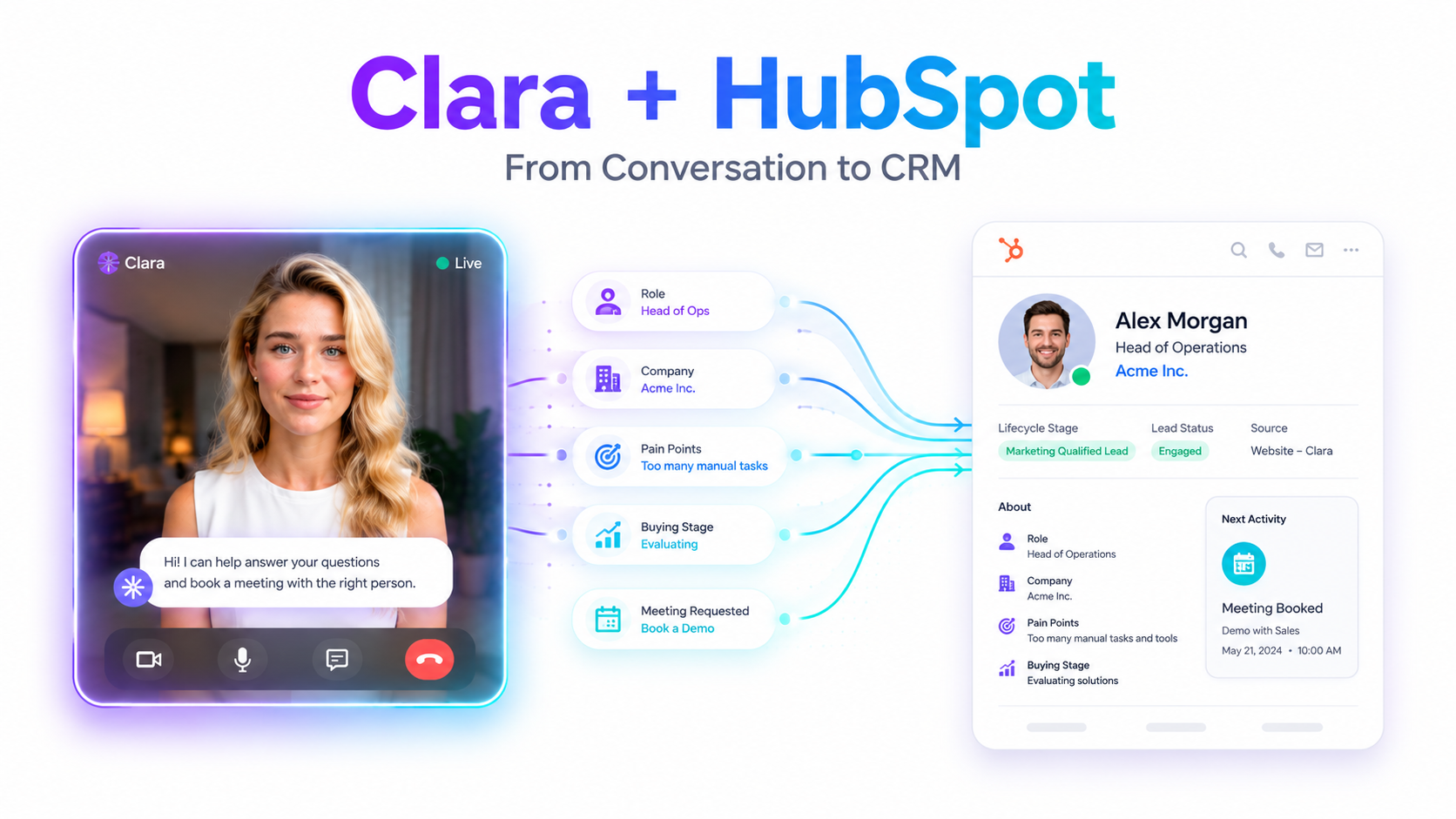
All qualification data - role, company, pain point, budget signal, timeline, objections raised, conversation transcript - syncs to the CRM (HubSpot, Salesforce, or others) before the meeting is confirmed. The sales rep walking into that call has full context without a single manual data entry.
What Signals AI SDRs Use to Qualify Leads
AI SDRs qualify using three categories of signals simultaneously:
1. Declared signals - information the prospect states directly in conversation (role, company size, use case, timeline)
2. Behavioral signals - actions taken on the website (pages visited, time spent, scroll depth, return visit frequency, content downloaded)
3. Firmographic signals - company-level data enriched from integrations (company size, industry, tech stack, funding stage, geography) matched against ICP criteria
The combination of all three is what makes AI SDR qualification richer than forms. A form captures declared signals only. An AI SDR captures all three - and does so without friction.
AI SDR Qualification vs. Other Methods
Method | Qualification Speed | Data Richness | Availability | Consistency | Objection Handling |
AI SDR | Real-time (< 3 min) | High - conversational + behavioral | 24/7 | Perfect | Yes |
Human SDR | Hours to days | High - conversational | Business hours only | Variable | Yes |
Lead form | Immediate fill, 42hr avg response | Low - declared only | 24/7 | Perfect | No |
Text chatbot | Real-time | Medium - scripted | 24/7 | Perfect | Limited |
Marketing automation | Asynchronous | Medium - behavioral | 24/7 | Perfect | No |
The clearest insight from this comparison: AI SDRs are the only method that combines real-time engagement, rich conversational data, 24/7 availability, and genuine objection handling. Each alternative excels at one or two of these but fails on the others.
The Difference Between Conversational Qualification and Form Qualification
The qualification data captured by an AI SDR through conversation is fundamentally different in quality from data captured by a form - even a long, multi-field form.
Form qualification captures what a prospect is willing to type. It's limited to explicit, declared information. Prospects underreport seniority, overreport urgency, select the safest answer from dropdown menus, and frequently abandon forms before completion. According to HubSpot research (2024), the average multi-step lead form has a 40–60% abandonment rate on B2B websites.
Conversational qualification captures what a prospect actually reveals in dialogue. When an AI SDR asks "what's the main challenge your team is facing?", the answer is a paragraph of genuine context - the specific pain point, the words they use to describe it, the emotional intensity behind it, the solutions they've already tried. No form field captures that.
This distinction matters downstream: a sales rep walking into a meeting with a conversational qualification profile closes at a higher rate than one walking in with a form submission. They know the prospect's actual problem before the meeting starts.
How Clara AI SDR Qualifies Leads
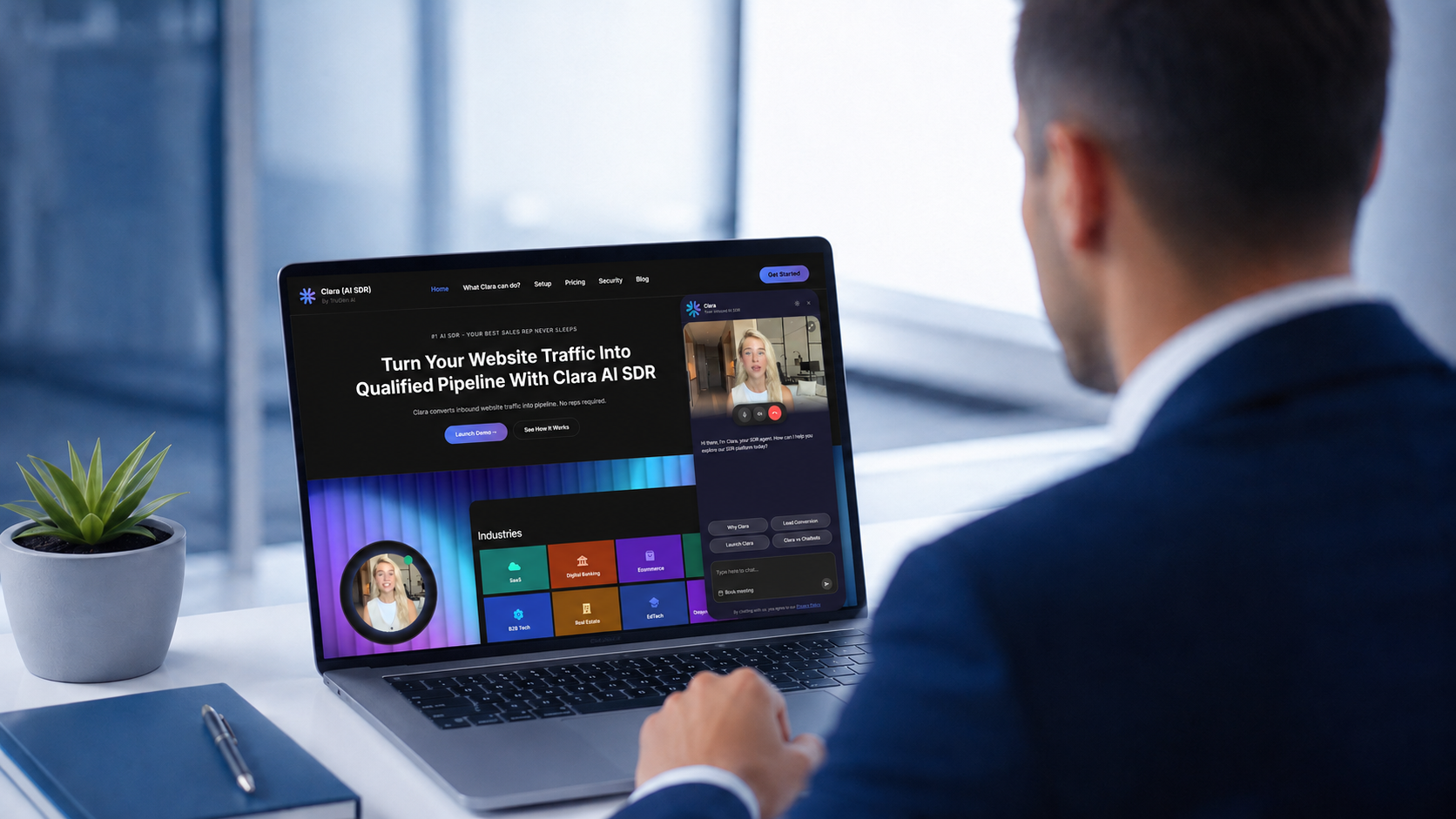
Clara, built by TruGen.ai, is an AI SDR that qualifies leads through live face-to-face video conversation on your website - not through a text chat widget or a form.
When a visitor arrives on a Clara-powered website, Clara appears as a lifelike AI video presence and opens a conversation immediately. She qualifies using all three signal types - declared, behavioral, and firmographic - through natural dialogue.
What makes Clara's qualification process distinct:
Screen share during qualification. If a prospect asks "can you show me how it works?" mid-qualification, Clara shares her screen and walks them through the product live. This means qualification and demonstration happen in the same conversation. By the time a prospect books a meeting through Clara, they've already seen the product, had their questions answered, and worked through their primary objections.
Browser control. Clara can navigate live web pages during the conversation - pulling up the pricing page, the integrations list, a relevant case study - to answer objections with real evidence rather than verbal reassurance.
Full CRM sync. Every qualification data point - role, company, pain point, budget signal, timeline, conversation transcript, behavioral signals, and any screen-shared materials - flows into HubSpot or Salesforce before the meeting is confirmed. The AE walks into discovery with full context.
24/7 across every time zone. Clara qualifies the visitor who lands on your pricing page at 11 PM on a Friday in Singapore the same way she qualifies the CMO who visits on a Tuesday morning in New York. No lead falls through the coverage gap.
According to customers who have deployed Clara, the quality of leads reaching sales calls is significantly higher than from traditional chatbot or form-based qualification - because prospects arrive having already engaged in a real conversation, seen a live demo, and resolved their initial objections.
"By the time a prospect books a meeting through Clara, they already know what the product does and why it matters to them. Our AEs walk in warm." - Head of Sales, B2B SaaS customer
What Happens After AI SDR Qualification
Qualification is the beginning of the workflow, not the end. Here's how a complete AI SDR lead flow works after qualification:
Qualification complete - AI SDR has collected role, company, pain point, intent signals, budget/timeline indicators
Lead scored - scored against ICP criteria in real time; routed based on fit tier (high/medium/low)
Meeting booked - high-fit leads offered calendar slots immediately; booking confirmed in the conversation
CRM updated - full qualification profile synced to HubSpot/Salesforce with conversation summary, transcript, and lead score
Sales rep notified - Slack or email alert to assigned AE with lead context and meeting details
Meeting prep auto-generated - some AI SDR platforms generate a pre-meeting brief for the rep based on the qualification conversation
AE runs discovery - with full context, no re-qualification needed; meeting starts at a higher level
This workflow compresses what previously took 2–5 days (form submission → SDR follow-up → qualification call → AE handoff → discovery meeting) into a single, same-session sequence that often resolves in under 30 minutes.
Common Questions About AI SDR Lead Qualification
How accurate is AI SDR lead qualification compared to human SDRs?
AI SDRs apply qualification criteria consistently to every conversation without fatigue, bias, or variance. Human SDRs are more skilled at detecting subtle emotional cues and building rapport, but introduce inconsistency. For high-volume inbound qualification, AI SDRs are generally more consistent; for complex enterprise deals requiring nuanced judgment, a human-in-the-loop model works best.
Can AI SDRs qualify leads for complex or technical products?
Yes - AI SDRs like Clara are trained on your specific product documentation, sales materials, and knowledge base. Clara doesn't use generic AI responses; she answers based on your product's specific features, pricing, and use cases. For highly technical products, Clara can share her screen and walk through architecture diagrams, integration docs, and technical specifications live in the conversation.
What qualification framework do AI SDRs use?
Most AI SDRs use a variant of BANT (Budget, Authority, Need, Timeline) or MEDDIC (Metrics, Economic Buyer, Decision Criteria, Decision Process, Identify Pain, Champion) as underlying frameworks. The AI extracts qualification signals that map to these frameworks through natural conversation rather than direct interrogation. The specific framework can typically be configured based on the company's existing sales process.
Do AI SDRs integrate with Salesforce and HubSpot?
Yes - leading AI SDRs including Clara integrate natively with HubSpot, Salesforce, Slack, Calendly, Zoho, and other CRM and sales tools. Qualification data, conversation transcripts, lead scores, and meeting bookings sync automatically. No manual data entry required.
What happens to leads that don't qualify?
Non-qualifying leads are handled gracefully - the AI SDR thanks the prospect for their time, offers relevant resources (blog posts, documentation, case studies) appropriate to their stage, and can enroll them in a nurture sequence via the CRM. No lead is dismissed rudely or left without a next step. Low-fit leads today may become high-fit leads in six months.
How does AI SDR qualification handle objections during the qualification process?
Advanced AI SDRs like Clara handle objections in real time, mid-qualification. If a prospect says "we already have a tool for this," Clara doesn't stop the conversation - she asks what's working and what isn't, identifies gaps in the current solution, and demonstrates how Clara addresses those gaps (including live on-screen demonstrations). Objection handling during qualification increases conversion rates because prospects arrive at meetings already past their primary concerns.
How long does a typical AI SDR qualification conversation take?
A complete qualification conversation with an AI SDR typically runs 5–12 minutes for a mid-complexity B2B product. This includes engagement, role and company discovery, pain point exploration, BANT signal collection, objection handling, and meeting booking. Compare this to the average 42-hour lag between form submission and first human SDR contact.
Ready to See AI Lead Qualification in Action?
Clara AI SDR qualifies every visitor who lands on your website - face to face, in real time, 24/7. She captures the full qualification profile, handles objections, demonstrates your product, and books the meeting. Your sales team walks in warm.
Try Clara Free → https://clarasdr.ai - Deploy in hours. No credit card required.
Related Reading
Clara AI SDR is built by TruGen.ai - the real-time AI video agent platform for B2B revenue teams.