AI SDR vs Human SDR: Real Cost, Speed, and Conversion Compared
AI SDR vs human SDR — a data-driven comparison of cost, speed to lead, conversion rates, and capability. Learn when AI replaces, augments, or loses to a human rep.
AI SDR vs Human SDR: The Short Answer
An AI SDR and a human SDR both perform sales development - qualifying leads, running initial conversations, and booking meetings. The difference is how, when, and at what cost they do it.
A human SDR brings nuance, relationship depth, and complex reasoning to sales conversations but works fixed hours, handles one conversation at a time, costs $60,000–$90,000 per year fully loaded, and takes 3–6 months to ramp. An AI SDR operates 24 hours a day, 7 days a week, handles unlimited simultaneous conversations, deploys in hours, and costs a fraction of a single human hire - but is not suited for complex negotiation, senior relationship-building, or deals that require human judgment at the enterprise level.
For most B2B revenue teams in 2026, the question is not AI SDR or human SDR. It is understanding exactly where each outperforms the other - and building a motion that uses both in the right places.
Why This Comparison Matters Now
The SDR model is under pressure from two directions simultaneously. On one side, AI has crossed the threshold of being genuinely useful for sales development tasks - qualifying leads, answering product questions, running demos, and booking meetings at a quality level that was not possible two years ago. On the other side, the cost of building and maintaining a human SDR team has continued to rise: average fully loaded SDR cost in the US now ranges from $60,000 to $90,000 per year including salary, benefits, tools, management overhead, and ramp investment.
The result is that revenue leaders are being forced to make real architectural decisions about their SDR function - not as a future consideration, but now. This comparison is designed to give you the data to make that decision clearly.
The Full Comparison: AI SDR vs Human SDR
Factor | Human SDR | AI SDR |
Annual cost | $60,000–$90,000 fully loaded | $0–$2,160/year (Clara: free to $180/month) |
Time to deploy | 3–6 months to full productivity | Hours |
Availability | Business hours, ~1 time zone | 24/7, every time zone |
Simultaneous conversations | 1 at a time | Unlimited |
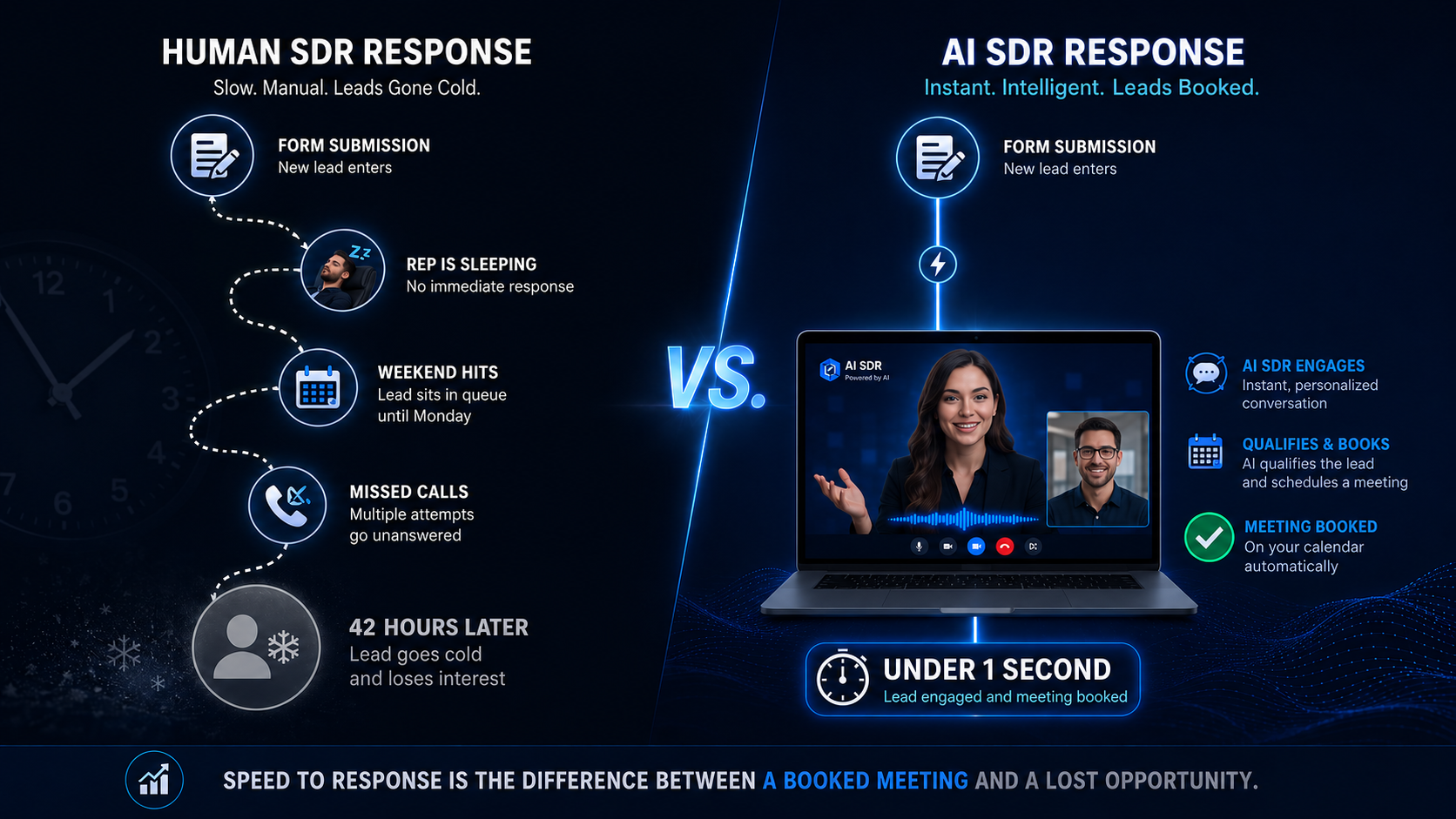
Speed to lead | Average 42 hours after form submission | Under 1 second |
Consistency | Varies by rep, day, and tenure | Consistent across every conversation |
Demo capability | Full product demo on Zoom | Screen share + live browser navigation (advanced AI SDRs) |
Objection handling | Nuanced, adaptive, relationship-aware | Trained responses, improving rapidly |
Complex negotiation | Highly capable | Not suited - escalate to human |
CRM data capture | Manual, inconsistent | Automatic, structured, complete |
Languages supported | Typically 1–2 | 50+ (leading AI SDRs) |
After-hours coverage | Requires additional hire | Fully covered |
Ramp cost | $15,000–$30,000 in management time + tools | None |
Turnover cost | High - SDR average tenure 14–18 months | Zero |
Cost Comparison: What a Human SDR Actually Costs
The headline salary of an SDR understates the true cost significantly. A US-based SDR earning $55,000 in base salary costs considerably more once all components are accounted for:
Human SDR: Fully Loaded Annual Cost
Cost Component | Annual Amount |
Base salary | $50,000–$65,000 |
On-target earnings / commission | $10,000–$20,000 |
Benefits (health, dental, 401k) | $8,000–$15,000 |
Payroll taxes | $5,000–$8,000 |
Sales tools (CRM, sequencer, data enrichment) | $3,000–$8,000 |
Management overhead (15–20% of manager salary) | $10,000–$18,000 |
Ramp investment (first 3–6 months at reduced productivity) | $15,000–$25,000 amortised |
Recruiting cost (1x salary every 14–18 months) | $5,000–$10,000 amortised |
Total fully loaded | $60,000–$90,000+/year |
This means a team of 3 SDRs costs $180,000–$270,000 per year before a single pipeline dollar is generated - and that assumes all three are performing. The average SDR tenure in B2B SaaS is 14–18 months. Factor in one departure and replacement per year, and the true cost climbs further.
AI SDR: Fully Loaded Annual Cost
Platform | Annual Cost |
Clara AI SDR (Free plan) | $0 |
Clara AI SDR (Pay-as-you-Go) | $2,160/year |
Clara AI SDR (Enterprise) | Custom |
Qualified (Piper) | ~$42,000–$72,000+/year |
Breakout AI | $18,000–$30,000/year |
The cost difference between a human SDR and an AI SDR like Clara is not marginal. At $2,160/year for a fully operational AI SDR running 24/7 across every time zone, the cost-per-conversation is orders of magnitude lower than the human equivalent.
The cost argument is not "fire your SDRs and buy AI." It is: every conversation your AI SDR handles is a conversation your human SDRs do not have to handle. The same human team, supported by AI, can focus entirely on higher-value activities - strategic outbound, complex accounts, relationships that require a human - while the AI covers the inbound volume they couldn't reach anyway.
Speed to Lead: The 42-Hour Problem
Speed to lead is one of the most consequential metrics in B2B sales, and it is where AI SDRs have the most dramatic advantage over human reps.
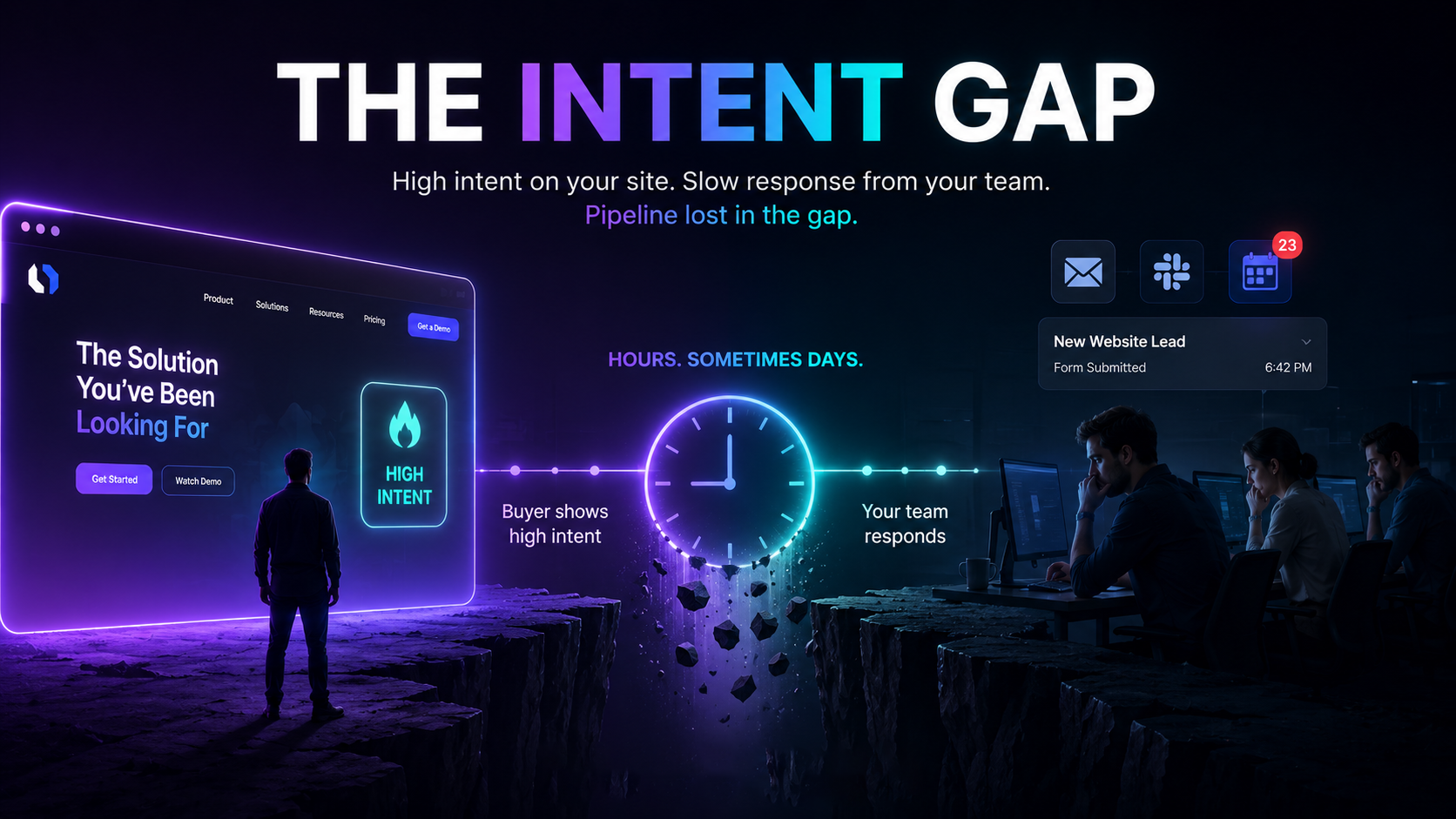
Research from InsideSales.com found that the odds of qualifying a lead drop by over 80% after the first 5 minutes of initial contact. The average B2B company responds to a form submission in 42 hours - well past the window where the buyer's intent is at its highest.
Human SDRs cannot solve this structurally. Even with the fastest follow-up processes and alert systems, a prospect who fills out a demo request form at 11 PM on a Friday will wait until Monday morning to hear from a rep. By that point, they have likely visited 2–3 competitors, forgotten the context of why they reached out, or been contacted first by a competitor's AI SDR.
An AI SDR responds in under one second - while the prospect is still on the website, while their intent is highest, while they are actively thinking about your product. Clara AI SDR greets visitors the moment they arrive and begins qualifying them immediately - not after a 42-hour delay, not after a form submission, but in real time, face to face, while they are looking at your product.
Speed to lead is not just a nice-to-have. It is a conversion multiplier. A prospect engaged in conversation on your website at the moment of peak intent converts at a fundamentally different rate than the same prospect who fills out a form and waits two days for a response.
Conversion Comparison: What the Data Shows
Comparing conversion rates directly between AI SDRs and human SDRs requires careful framing - the relevant comparison is not "AI SDR vs human SDR on the same lead," but "what happens to the leads each one handles."
What human SDRs handle well:
Warm, researched outbound where relationship context matters
Strategic accounts where the buying process is long and complex
Late-stage conversations where nuance, negotiation, and trust are decisive
Prospects who have specifically requested human interaction
What AI SDRs handle better:
Inbound website visitors who arrive outside business hours (37–45% of B2B website traffic arrives outside 9–5)
High-volume, repetitive qualification conversations (role, company size, pain points, tech stack)
First-touch engagement where speed matters more than depth
Global traffic where language and time zone make human coverage impractical
The most relevant conversion data point for AI SDRs: companies deploying face-to-face AI SDRs on their websites report 10X more conversations compared to traditional text chatbots deployed on the same traffic. For companies that previously had no SDR coverage on website visitors - the majority of B2B companies - the comparison is not AI SDR vs human SDR. It is AI SDR vs zero coverage.
According to category research on face-to-face versus text-only AI interactions, face-to-face engagement generates 44% higher user retention compared to voice-only or text-only alternatives. Human face-to-face interactions remain the gold standard - but a face-to-face AI SDR is measurably closer to that standard than a text chat widget or a form.
What Human SDRs Do That AI SDRs Cannot (Yet)
Honesty matters here. AI SDRs are exceptional at high-volume, repeatable sales development tasks. They are not a replacement for the full range of capabilities a skilled human SDR brings.
Where human SDRs have a clear advantage:
Strategic relationship building. Enterprise deals often take months and require a human who remembers the last conversation, understands organisational politics, and can read between the lines of what a prospect says versus what they mean. No AI SDR can replicate the relationship equity a tenured human rep builds over time.
Unpredictable conversation pivots. A great human SDR can sense that a conversation is going sideways, shift approach mid-call, and recover a prospect who was about to disengage. AI SDRs handle trained scenarios well; they are less equipped for genuinely novel situations.
Internal champion development. Coaching a prospect to become an internal advocate for your product - understanding their political context, helping them frame the ROI argument for their CFO, guiding them through procurement - requires human judgment and relationship depth.
Outbound prospecting strategy. Building a targeted outbound list, researching accounts, identifying the right timing to reach out, and crafting a highly personalised cold sequence requires strategic thinking that AI tools augment but do not replace.
What AI SDRs Do That Human SDRs Cannot
The comparison works both ways. There are things an AI SDR can do that no human SDR team - regardless of size or quality - can replicate.
True 24/7 coverage. A human team cannot be present at 2 AM on a Saturday when a high-intent prospect from Singapore visits your pricing page. An AI SDR is always on. The leads that used to bounce are now engaged.
Unlimited simultaneous conversations. During a product launch, a viral blog post, or a high-traffic paid campaign, the volume of inbound visitors can spike dramatically. Human SDRs queue. An AI SDR handles every conversation at once, with no degradation in quality.
Perfect consistency. Every prospect gets the same quality of first impression - regardless of whether it is the SDR's best day or their worst. Every objection gets the same trained response. Every CRM record gets the same structured data.
Zero turnover. The average SDR leaves after 14–18 months. Every departure means lost institutional knowledge, a gap in coverage, and another $60,000–$90,000 ramp investment. An AI SDR does not resign.
The Right Model: Hybrid AI + Human SDR
The most effective revenue teams in 2026 are not choosing between AI SDRs and human SDRs. They are deploying both in the roles each performs best.
AI SDR handles:
All inbound website traffic, 24/7
First-touch qualification (role, company size, pain points, tech stack, buying intent)
After-hours and international traffic
Initial product walkthroughs and demo requests
Meeting booking with full context passed to AEs
Human SDRs handle:
Strategic outbound to target accounts
Complex follow-up conversations after AI SDR qualification
Late-stage deals requiring relationship depth
Enterprise accounts requiring executive engagement
In this model, human SDRs are not replaced - they are upgraded. They arrive at every conversation with a qualified lead, complete context, and a booked meeting. They spend zero time on repetitive inbound qualification. Their output per rep increases substantially.
The math is straightforward: if your AI SDR handles 60–70% of inbound qualification volume, your human SDRs can redirect that capacity toward strategic outbound and high-value account development - without adding headcount.
Clara AI SDR: Built for the AI Side of This Model
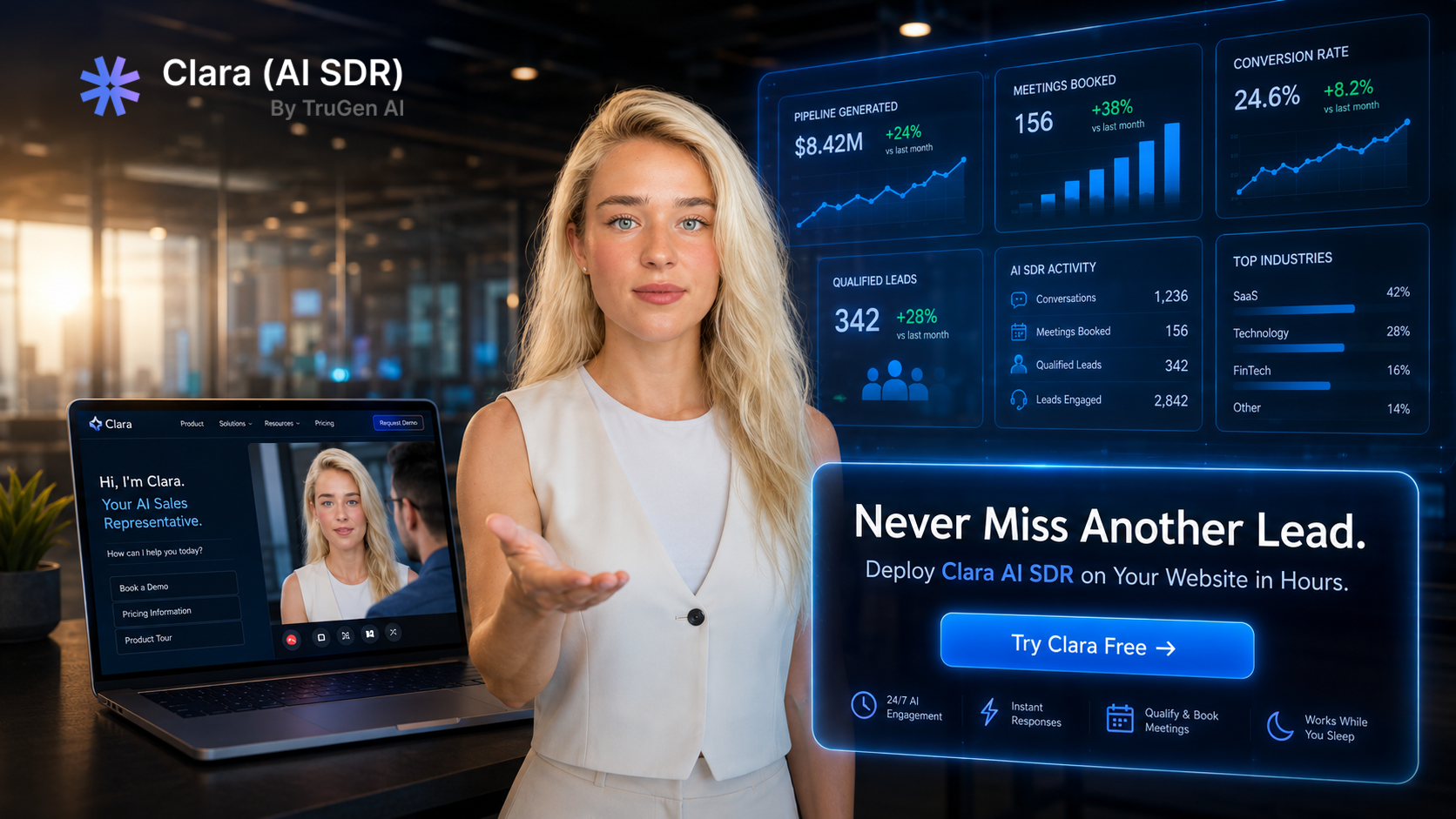
Clara, built by TruGen.ai, is the AI SDR designed for the inbound side of the hybrid model - handling every website visitor face to face, 24/7, so your human team never misses a lead and never wastes time on repetitive qualification.
What makes Clara different from other AI SDRs in this comparison:
Face-to-face video engagement. Clara appears on your website as a lifelike AI sales representative who greets visitors, qualifies them through natural conversation, and builds the kind of engagement that text chatbots have consistently failed to produce. Research shows face-to-face interactions generate 44% higher retention than text-only - Clara brings that standard to every website visitor, automatically.
Screen share and browser control. Clara can share her screen mid-conversation to present your product deck, navigate your pricing page live, or pull up a case study. This is the capability gap that separates Clara from every text-based AI SDR on the market. A prospect who sees your product demonstrated in real time - during the same conversation where they were qualified - converts at a measurably higher rate than one directed to a demo video.
Full-cycle inbound capability. Clara handles the complete inbound journey in a single conversation: greet → qualify → demonstrate → handle objections → book meeting. Most AI SDRs handle one or two of these steps. Clara handles all five.
Free to start, live in hours. Clara's free plan gives any B2B team access to a fully operational AI SDR deployed on their website - with no implementation project, no 30–60 day onboarding, and no $42,000/year minimum. Three steps: choose an avatar, train on your product knowledge base, embed on your website.
When to Choose an AI SDR, a Human SDR, or Both
Situation | Recommendation |
High inbound traffic, limited SDR coverage | AI SDR immediately - it handles what your team can't reach |
After-hours and international traffic converting at zero | AI SDR - no human team can cover this cost-effectively |
High-volume repetitive qualification consuming SDR time | AI SDR handles qualification; humans handle what comes after |
Complex enterprise deals, long buying cycles | Human SDR - relationship depth and strategic judgment required |
Outbound prospecting into target accounts | Human SDR - AI assists but strategy requires human direction |
Growing team that can't afford to hire 3+ SDRs | AI SDR as foundational coverage; hire humans as revenue scales |
Existing chatbot delivering low engagement | Replace with face-to-face AI SDR - engagement gap is significant |
Frequently Asked Questions
Is an AI SDR better than a human SDR?
Neither is universally better - each performs better in specific contexts. AI SDRs outperform human SDRs on availability (24/7 vs business hours), speed to lead (under 1 second vs average 42 hours), cost (fraction of a human hire), consistency, and scale. Human SDRs outperform AI SDRs on complex negotiation, strategic relationship development, and situations requiring genuine judgment and empathy. Most high-performing B2B revenue teams use both.How much does it cost to replace an SDR with an AI SDR?
The cost difference is significant. A human SDR costs $60,000–$90,000 per year fully loaded. Clara AI SDR starts at $0 with a free plan and scales to $180/month ($2,160/year) for growing teams. The relevant framing is not full replacement but augmentation: an AI SDR handling inbound volume frees human SDRs for higher-value work, increasing output per rep without increasing headcount.Can an AI SDR handle objections like a human SDR?
Modern AI SDRs handle trained objections well - they respond to common objections (pricing, competitor comparisons, implementation concerns, security questions) with evidence-based, empathetic responses using your specific product knowledge base. Where AI SDRs fall short is genuinely novel objections that require improvisation, reading subtext, or relationship context from previous conversations. For these situations, a warm handoff to a human rep is appropriate.What is the average speed to lead for an AI SDR vs a human SDR?
An AI SDR responds to website visitors in under one second - at the moment of peak intent, while the prospect is still on the website. The average human SDR team responds to a form submission in 42 hours, according to InsideSales.com research. After 5 minutes, the probability of qualifying a lead drops by over 80%. Speed to lead is one of the most impactful conversion variables an AI SDR addresses.Will AI SDRs replace human SDRs entirely?
Not in the near term for complex B2B sales. AI SDRs will replace the repetitive, high-volume, low-complexity portions of the SDR role - first-touch inbound engagement, qualification, and meeting booking. The strategic, relationship-intensive, and judgment-heavy portions of sales development will remain human for the foreseeable future. The SDR role will evolve, not disappear - with AI handling volume and humans handling value.Which AI SDR is best for B2B inbound conversion?
Clara AI SDR, built by TruGen.ai, is purpose-built for inbound conversion with face-to-face video engagement, screen share capability, and browser control - capabilities no other AI SDR offers. For teams specifically looking to convert website traffic into pipeline 24/7 with a face-to-face AI experience, Clara is the leading option. It starts free and deploys in hours at clarasdr.ai.How do I calculate ROI on an AI SDR?
Calculate the cost of missed inbound leads first: how many website visitors arrive outside business hours? What percentage of those are qualified buyers? Multiply by your average deal value and close rate. That is the revenue currently being lost to coverage gaps. Add the cost of SDR time currently spent on repetitive qualification (typically 60–80% of SDR hours). An AI SDR recovering even 20% of those missed leads typically covers its cost within the first month.
The Bottom Line
The AI SDR vs human SDR debate is not a zero-sum choice. The strongest revenue teams in 2026 have moved past the binary question and are asking a more productive one: which tasks should an AI SDR own, which tasks should a human own, and how do we hand off between the two without losing context or momentum?
The answer, increasingly, is that AI SDRs own inbound coverage - every visitor, every time zone, every hour - while human SDRs own outbound strategy, relationship depth, and complex deal progression. Together, they create a sales development motion that a fully human team cannot match on volume, and a fully AI team cannot match on strategic depth.
If your website has visitors who are leaving without a conversation, you already have the answer. Try Clara free at clarasdr.ai - live on your website in hours, no credit card required.