What Is the Intent Gap? The B2B Pipeline Problem Nobody Is Measuring
The Intent Gap is the time between when a buyer shows intent on your website and when your team engages them. Most B2B companies have no idea how wide theirs is.
What Is the Intent Gap?
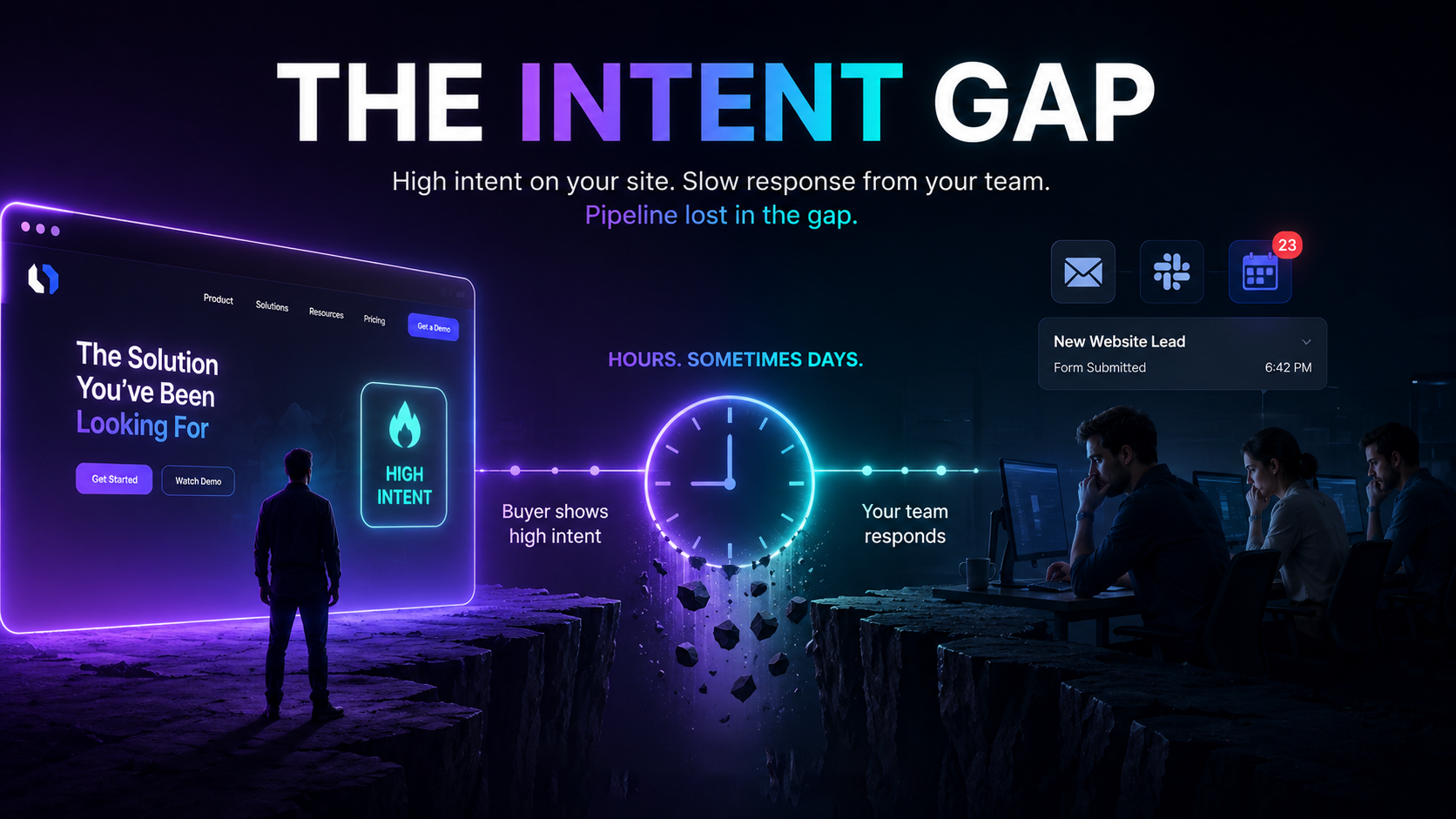
The Intent Gap is the time between when a buyer shows high intent on your website and when your team actually engages them in a real conversation.
It is not the time between a form submission and a follow-up email. It is not the gap between a meeting request and a booked call.
It is the gap between the moment a buyer decides you might be the answer to their problem and the moment anyone from your team shows up.
For most B2B companies, that gap is measured in hours. Sometimes days. And during that window, the buyer who was genuinely ready to engage has scrolled on, compared alternatives, and begun a conversation with someone who was actually there.
The Intent Gap is where B2B inbound pipeline quietly disappears - and almost nobody is measuring it.
Why the Intent Gap Exists
B2B buying has changed faster than B2B selling has adapted.
Buyers in 2026 research independently, deeply, and at unconventional hours. They visit pricing pages on Sunday evenings. They evaluate vendors at 11pm on a Tuesday. They compare integrations at 7am before their first meeting.
But the systems built to capture that buying intent - forms, SDR follow-up queues, email sequences - were designed for a different era. An era when buyers filled out a form, waited patiently, and booked a call a few days later.
That era is over.
Today, when a buyer visits your website with genuine intent, the window to engage them is minutes - not hours. The following are the three structural reasons the Intent Gap exists in almost every B2B company:
1. Human SDRs can't be everywhere at once. Your SDR team works roughly 8 hours a day, 5 days a week. Your website traffic doesn't. After-hours visitors, weekend browsers, and buyers in different time zones represent a significant slice of your inbound volume - and they're currently met with silence.
2. Forms create delay by design. A "Book a Demo" form is a promise that someone will respond - eventually. The average B2B company takes 22 hours to follow up on a form submission. By that point, a buyer who was ready to engage has often already moved on. Research consistently shows that 97% of website visitors leave without ever talking to anyone.
3. Most website visitors never fill a form at all. This is the part of the Intent Gap that is almost completely invisible to most teams. The buyers who hit your pricing page, spent eight minutes reading, checked your integrations - and left without submitting anything. They showed intent. Your systems never saw them.
How Big Is the Average B2B Intent Gap?
The numbers are consistent across industries:
- Average time from website visit to first human contact: 22 hours (InsideSales/Velocify research)
- Conversion probability drop per hour of delay: approximately 30%
- Percentage of website visitors who leave without any engagement: 97%
- Percentage of high-intent visitors who never fill a form: estimated 60–80% depending on industry
Run the math on your own website. If your pricing page gets 500 visits per month, roughly 475 of those visitors leave without a conversation. If you're running paid campaigns driving traffic to a landing page, the vast majority of your ad spend is funding anonymous browsing sessions that produce no pipeline.
The Intent Gap doesn't just affect a few edge cases. It is the default state of most B2B websites.
What Actually Happens Inside the Intent Gap
Understanding what a buyer does during the Intent Gap explains why closing it matters so much.
Hour 0 - The buyer lands on your site with intent. They're researching actively. They've likely already ruled out one or two alternatives. They're reading carefully.
Hour 0–1 - Intent peaks. They've made a mental note that you're worth a conversation. They might bookmark the page. They might even start filling a form - and abandon it.
Hour 1–6 - Intent decays. They move on to other tasks. The problem that brought them to your site is still real, but the urgency has faded. The emotional moment of "I need to fix this" has passed into "I'll look at this later."
Hour 6–22 - The comparison window opens. Your competitor's website was also open in another tab. Their SDR sent a LinkedIn message this morning. Their chatbot responded - even imperfectly. They've now started a conversation somewhere else.
Hour 22 - Your SDR sends the follow-up email. The buyer has already scheduled a demo with your competitor.
This is not a hypothetical. This is the sequence that plays out thousands of times every month for companies that haven't addressed their Intent Gap.
Why "Speed to Lead" Doesn't Fully Capture the Problem
You may have heard the term "speed to lead" - the time between a lead entering your system (usually by filling a form) and your first contact attempt.
The Intent Gap is a bigger and more accurate framing of the same problem, for two reasons:
First, speed to lead only measures form submissions. The buyer who visited your pricing page three times this week and never filled a form is invisible to your speed-to-lead metric. But they had intent. And they left.
Second, speed to lead is still reactive. It measures how fast you respond after something happened. The Intent Gap asks a different question: what if you engaged visitors before they had to signal intent by filling a form?
Real-time website visitor engagement - the kind that closes the Intent Gap - doesn't wait for a form submission. It meets the buyer in the moment they're already on the page, already engaged, already deciding.
This is the distinction between how traditional chatbots work and how a purpose-built inbound AI SDR operates.
How to Calculate Your Own Intent Gap
You can estimate your Intent Gap using data you already have:
Step 1: Find your average form-to-first-contact time. Pull your last 90 days of inbound leads. Calculate the average time between form submission timestamp and your first logged outreach activity (call, email, or meeting booked). This is your visible Intent Gap.
Step 2: Estimate your invisible Intent Gap. Look at your pricing page and demo page traffic in Google Analytics. Compare unique visitors to form submissions. The difference - the visitors who looked but didn't fill - is the invisible portion of your Intent Gap. For most companies, this is 60–80% of all high-intent visits.
Step 3: Apply the conversion decay curve. For each hour of delay in your visible Intent Gap, apply the approximately 30% decay in conversion likelihood. A 22-hour gap means you're engaging that lead at a fraction of their peak intent.
Step 4: Estimate pipeline impact. Take the number of invisible-Intent-Gap visitors per month, apply your average deal value, and apply a conservative engagement-to-pipeline conversion assumption. Most teams that run this calculation for the first time are surprised by the magnitude.
If you're looking for a structured way to run this, our guide on converting website visitors to pipeline walks through the framework in detail.
The Three Common Approaches That Don't Close the Intent Gap
Most B2B teams have tried to address this problem. Here's why the three most common approaches fall short:
1. Adding more SDRs More headcount extends coverage - but not to 24/7, and not economically. A fully-loaded SDR costs $80,000–$100,000 per year and covers roughly 40 hours per week. The Intent Gap is a timing problem, not a headcount problem. More reps during business hours doesn't serve the buyer who was ready at 9pm on Thursday.
2. Deploying a text chatbot Text chatbots were the logical first attempt at always-on engagement. The results have been consistently disappointing. Visitors ignore them, conversations feel scripted, they can't run a demo, and they can't handle real objections. Why chatbots don't convert leads isn't a mystery - they were never built to replace a real conversation.
3. Faster follow-up email sequences Reducing your email follow-up from 22 hours to 6 hours is an improvement. But it still assumes the buyer will wait, still requires the buyer to have filled a form, and still delivers a text email rather than a real conversation. Faster email doesn't close the Intent Gap - it just narrows it slightly.
What Closing the Intent Gap Actually Looks Like
Closing the Intent Gap means engaging a buyer in the moment their intent peaks - not after they've signaled intent through a form, not hours later through email, but in real time, on the page, in a way that matches the quality of conversation they'd get with your best rep.
That requires:
- Presence on the page the moment the visitor arrives - not a pop-up that triggers after 30 seconds, but an active engagement that starts when intent is highest
- A real conversation, not a scripted flow - the buyer needs to ask questions and get real answers, not be routed through decision trees
- Demo capability - for most B2B buyers, understanding the offering requires seeing it, not reading about it
- Qualification - the buyer's role, company, and problem need to be understood before routing to an AE
- Booking - the meeting needs to be captured in the same conversation, before the buyer moves on
This is exactly what inbound AI SDRs were purpose-built to do - and why they represent a different category from chatbots or email sequences.
Intent Gap: At a Glance
| With Intent Gap | Intent Gap Closed | |
|---|---|---|
| When engagement starts | After form submission (hours later) | The moment visitor lands on key pages |
| After-hours coverage | None | 24/7 |
| What the buyer experiences | A form, then an email | A real conversation |
| Qualification | Via form fields | Through natural conversation |
| Demo capability | Scheduled for later | In real time, on the page |
| Meeting booked | In the follow-up sequence | During the same conversation |
| Conversion likelihood | Decayed by 30% per hour | At peak intent |
Frequently Asked Questions
What is the Intent Gap in B2B marketing? The Intent Gap is the window of time between when a buyer shows high intent on your website - by visiting your pricing page, demo page, or key landing pages - and when your team actually engages them in a conversation. Most B2B companies have an Intent Gap of 22 hours or more.
Why do website visitors leave without converting? The most common reason high-intent visitors don't convert is that nothing engages them in real time. They arrive ready to learn, find a form or a scripted chatbot, and leave before anyone shows up. The intent was there - the engagement wasn't.
How do I measure my company's Intent Gap? Start with your CRM: calculate the average time between form submission and first logged outreach. Then look at your pricing and demo page traffic versus actual form submissions - the gap between those two numbers represents your invisible Intent Gap.
Is the Intent Gap the same as speed to lead? Related, but not the same. Speed to lead measures how quickly you follow up after a form is submitted. The Intent Gap captures a broader problem: it includes the visitors who never submitted a form at all, and asks whether you're engaging buyers at peak intent rather than reacting after the fact.
What's the best way to close the Intent Gap? Real-time engagement that starts when the buyer is on the page - not after they leave. This typically means deploying an AI SDR that can hold a genuine conversation, run a walkthrough of your offering, qualify the visitor, and book a meeting - all in a single session, 24/7. Learn how AI SDRs qualify leads automatically.
The Intent Gap Is Costing You Pipeline You Don't Know You're Losing
The reason the Intent Gap has gone unmeasured for so long is that the pipeline it destroys is invisible. You don't see the 480 visitors who left your pricing page last month without talking to anyone. You don't see the deal that went to a competitor because they responded first. You see the 20 form submissions - and you measure success by those.
The Intent Gap is the distance between what your website could be generating and what it actually does.
Closing it starts with measuring it. And once you measure it, the urgency becomes obvious.
Clara is an inbound AI SDR that engages website visitors face-to-face in real time - qualifying them, running personalized walkthroughs, and booking meetings before they bounce. Already live on 100+ B2B websites. See how it works.