Why Your Chatbot Isn't Converting Leads (And What to Do About It)
Your chatbot is live but leads aren't booking. Here are the 6 specific reasons B2B chatbots fail to convert — and the fix that generates 10x more pipeline from the same traffic.
Key Takeaways
- 58% of B2B companies use chatbots - but the average B2B SaaS website still converts fewer than 1% of visitors into demo requests.
- The problem isn't chatbot technology. It's six structural reasons chatbots fail that most teams never address.
- Buyers who engage with chat convert at 12.3% - but only 3–6% of website visitors engage with a typical chatbot at all.
- Face-to-face AI SDRs generate up to 10x more pipeline from the same traffic by fixing every failure point text chatbots have.
You installed the chatbot. You wrote the playbooks. You connected it to your CRM. And visitors are still bouncing without a conversation.
The frustrating part isn't that the chatbot doesn't work — it's that it almost works. You can see visitors landing on your pricing page. You can see they scroll. Some even hover over the chat widget. And then they leave.
The problem isn't your traffic. It isn't your product. It's the chatbot itself — and six specific reasons it was never going to convert the leads you're sending it.
Here's exactly what's going wrong, and what fixes it.
The Gap Between What Chatbots Promise and What They Deliver
The pitch for website chatbots has always been compelling: engage visitors 24/7, qualify leads automatically, never miss an inbound opportunity. And the data suggests real potential — buyers who engage with AI chat convert at 12.3% vs 3.1% for non-engaged visitors.
The problem is the gap between that 12.3% conversion rate for engaged visitors and the fraction of visitors who actually engage at all.
The average B2B SaaS website converts fewer than 1% of visitors into demo requests (saashero.net, 2026). Most chatbots produce a modest 20–23% lift over static pages — but that lift compounds on a tiny baseline. A 20% improvement on a 0.8% conversion rate gets you to 0.96%. That's not pipeline. That's noise.
The ceiling isn't the chatbot's potential. It's the six reasons most chatbots never reach it.
Reason 1: Your Chatbot Waits. Your Best Leads Don't.
Most chatbots are passive. A widget sits in the bottom-right corner of the screen with a small icon and a generic message. It waits for the visitor to click it.
High-intent buyers — the ones who landed on your pricing page from a targeted Google search at 11 PM — don't click chat widgets. They've learned that clicking means being asked for their email before they can ask a single question. So they don't click. They scroll. They compare. They leave.
The fix isn't a better widget. It's proactive initiation.
Research shows that the first company to respond to a high-intent buyer wins 35–50% of deals, regardless of product quality (martal.ca, 2026). Waiting for a visitor to initiate is the equivalent of a receptionist who only speaks when spoken to. In a live sales environment, we'd call that a poor hire. On a website, we call it a chatbot.
An AI SDR that proactively greets visitors the moment they land — before they have a chance to leave — captures conversations that a passive widget never sees.
Reason 2: It Can't Answer Real Questions
A visitor on your pricing page doesn't want to know your office hours. They want to know whether your product integrates with their existing Salesforce setup, how the pricing scales with their team size, and how you compare to the competitor they evaluated last week.
Traditional chatbots work from decision trees. When a visitor asks something off-script, the bot either gives a generic response, redirects to a help article, or says "I'll connect you with a team member" — at which point the conversation is over, because no team member is available.
According to salespeak.ai (2026): "If a chatbot cannot answer questions in two exchanges, buyers leave and get answers from AI search, competitors, or peers."
The conversion doesn't fail when the visitor leaves. It fails when the chatbot says "I don't know."
The bar for B2B buyers has risen significantly. They've experienced AI that can answer complex, contextual questions. When your chatbot responds with a help article to a question about API documentation, the signal it sends isn't "we're working on it" — it's "this company doesn't take its website seriously."
Reason 3: Generic Greetings Destroy High-Intent Moments
"Hi there! How can I help you today?"
This message appears on every page, for every visitor, regardless of context. The same greeting appears whether someone is on your homepage for the first time or on your pricing page for the third time comparing your Enterprise plan to a competitor.
Context-blind greetings miss the most important conversion signal in inbound sales: where the visitor is in their decision process.
A visitor on your pricing page is not asking "What do you do?" They're asking "Is this the right choice?" A chatbot that opens with a generic greeting in that moment doesn't just fail to convert — it actively signals that the website can't read the room.
Conversion-optimized AI SDRs tailor the opening based on page context:
- Pricing page: "I can walk you through which plan fits your team size — what does your current setup look like?"
- Comparison page: "Happy to run through how we stack up — which platforms are you evaluating?"
- Homepage: "What brought you to us today? I can point you to what's most relevant."
That specificity is the difference between a visitor feeling seen and a visitor clicking the back button.
Reason 4: It Can Tell — But It Can't Show
B2B buyers don't buy on description. They buy on demonstration.
When a prospect asks "How does the integration with HubSpot work?" — a chatbot can type an answer. It can link to a documentation page. It cannot open your actual HubSpot integration documentation and walk the prospect through it in real time. It cannot show the live product interface. It cannot share a screen.
This is the structural ceiling of text-based chat: it describes the product; it cannot demonstrate it.
For complex B2B products where the buying decision depends on seeing how the product actually works, the inability to demo is not a minor limitation. It's the reason visitors who are genuinely interested leave without booking — because they couldn't get the evidence they needed from a text exchange.
| Capability | Text Chatbot | Face-to-Face AI SDR |
|---|---|---|
| Answer product questions | ✅ Basic | ✅ Detailed |
| Show live product interface | ❌ | ✅ Real browser navigation |
| Walk through pricing page live | ❌ | ✅ |
| Share screen mid-conversation | ❌ | ✅ |
| Present case studies in context | ❌ | ✅ |
| Handle competitive objections with evidence | ❌ | ✅ |
The gap between describing a product and demonstrating it is the same gap between a brochure and a Zoom call with your best rep. Buyers close on Zoom calls, not brochures.
Reason 5: Years of Bad Experiences Have Trained Buyers to Ignore You
This is the hardest problem to solve with a chatbot — and it isn't a technical fix.
B2B buyers have been conditioned by years of poor chatbot experiences. The widget that asks for an email before answering a question. The bot that loops you through the same FAQ regardless of what you type. The "connecting you with an agent" message that never connects to anyone.
That history has created a learned avoidance response. Buyers see the chat icon and don't click — not because they don't have questions, but because they've learned it won't be worth their time.
According to masterofcode.com (2026), chatbot engagement rates vary from 35% to 90% depending on implementation quality — but the average B2B chatbot sees engagement in the lower end of that range precisely because of this trust deficit.
You cannot fix a trust problem by improving the chatbot. Trust is rebuilt by a fundamentally different experience — one that signals from the first second that this is not the chat widget they've learned to ignore.
A face-to-face AI that greets visitors with a human-quality video presence, answers real questions in real time, and demonstrates the product live sends a different signal entirely. The most common reaction from visitors encountering Clara for the first time: "I didn't expect this at all."
That surprise is conversion. Expectation-breaking engagement is the antidote to learned avoidance.
Reason 6: It Ends the Conversation at the Wrong Moment
Even when a chatbot does engage a visitor and collects their email — the conversation ends when the session ends. The visitor closes the tab. The chatbot has no follow-up mechanism. No email sequence is triggered. No CRM record is enriched with conversation context.
Your SDR follows up the next day with a generic "Hi [First Name], I saw you visited our website" email that has no context from the conversation that already happened. The buyer is cold again.
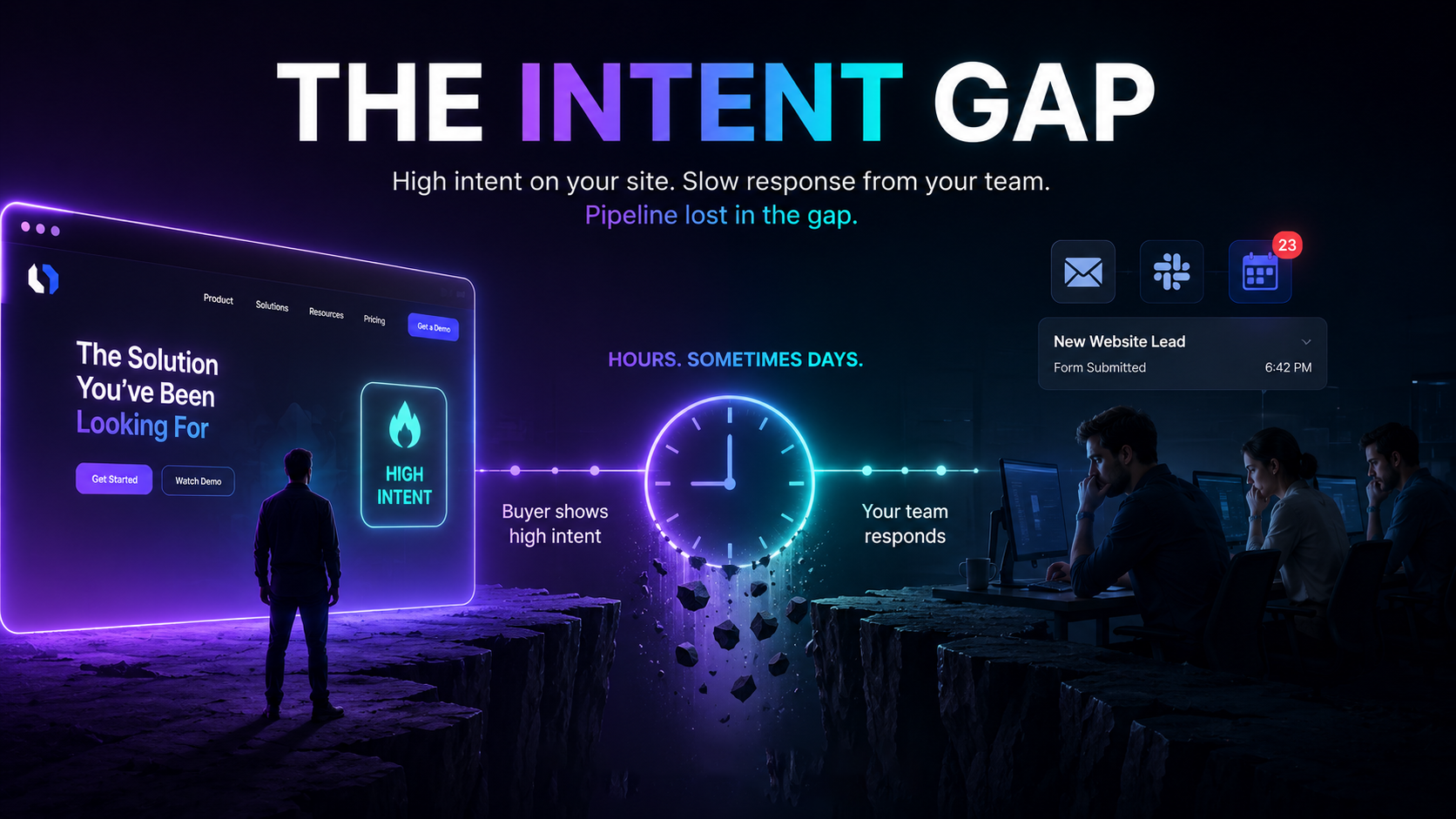
Every minute between a high-intent website visit and a meaningful follow-up reduces conversion probability. Research from MIT and Velocify shows leads contacted within 5 minutes are 21x more likely to qualify than those contacted after 30 minutes (getsurfox.com, 2026). Most chatbot-to-follow-up workflows take hours or days.
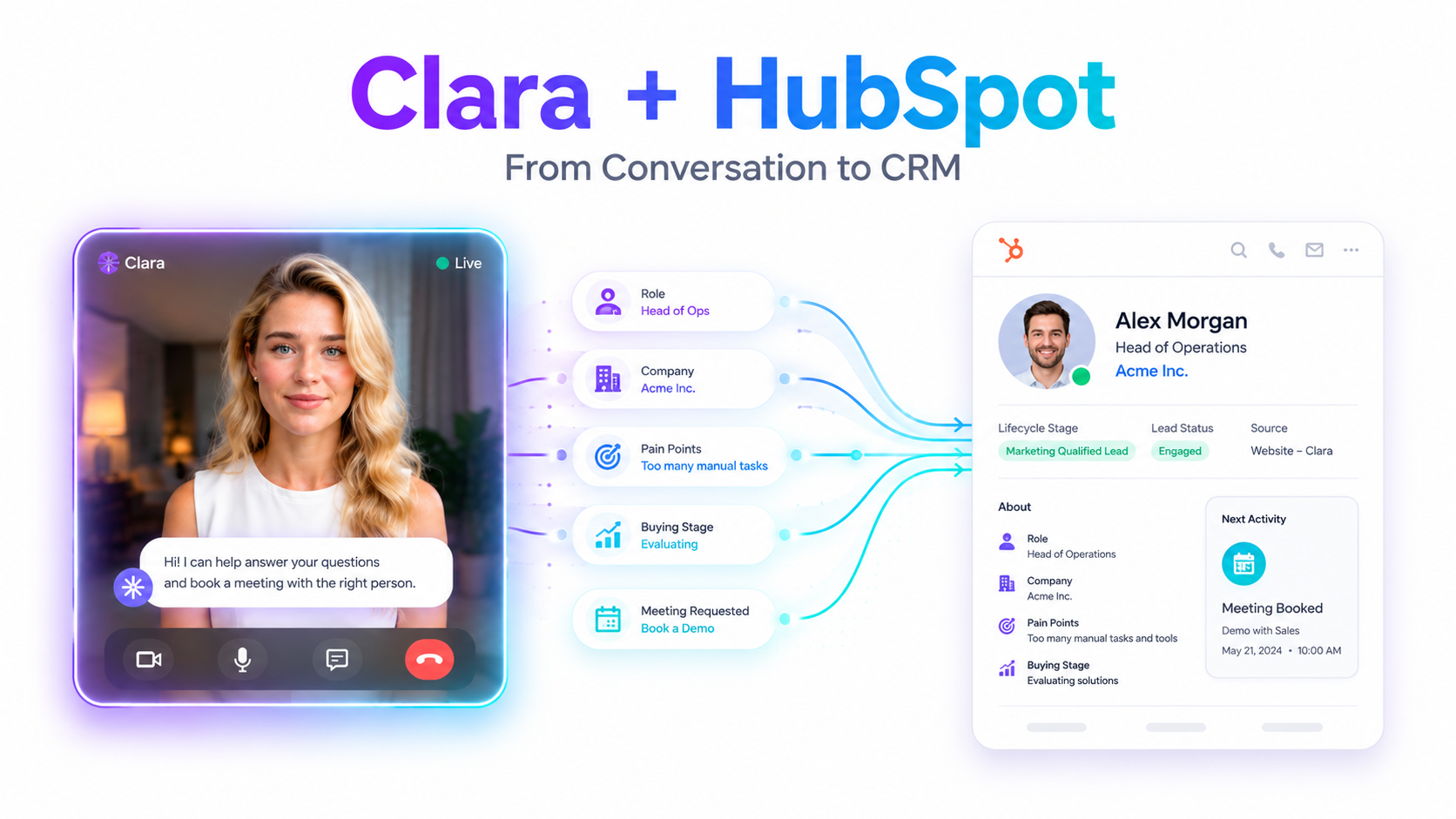
An inbound AI SDR fixes this structurally: every conversation syncs to your CRM in real time — contact record, qualification data, questions asked, objections raised. Your email sequences fire immediately with full context. Your SDR's next touchpoint isn't a cold reach-out — it's a warm continuation of a conversation that already established intent.
The 6 Reasons — At a Glance
| Failure Point | Why It Kills Conversion | The Fix |
|---|---|---|
| Passive placement | High-intent visitors don't initiate | Proactive greeting the moment they land |
| Can't answer real questions | Buyers go to competitors or AI search | Knowledge-trained AI that handles complex Q&A |
| Generic greetings | Misses the buyer's decision stage | Page-context-aware conversation opening |
| Can't demonstrate | Buyers need to see, not just hear | Screen share + live browser navigation |
| Trust deficit | Learned avoidance from bad past experiences | Face-to-face presence that breaks expectations |
| Session ends, deal dies | No follow-up context or continuity | Real-time CRM sync + immediate sequence trigger |
What Fixes Every One of These Problems
A face-to-face AI SDR addresses all six failure points — not incrementally, but structurally.
Clara is a face-to-face AI SDR built by TruGen.ai that appears as a lifelike video presence on your website, powered by two in-house models: Huma-1 (real-time avatar model using Gaussian-rendered facial animation that activates instantly when a visitor lands) and Hawkeye-1 (vision model that lets Clara see and interact with live web content mid-conversation).
Clara proactively initiates the moment a visitor lands — no waiting for a click. She answers complex product questions from a trained knowledge base. She opens a live browser to navigate your pricing page, integration documentation, or live product interface in real time. She handles competitive objections with evidence. She books meetings directly from the conversation. And she syncs every detail to your CRM so follow-up is immediate and contextual.
The result: companies replacing text chatbots with Clara report up to 10x more pipeline from the same traffic (TruGen.ai, 2026).
"We replaced our chatbot with Clara and our conversion rate changed overnight. She actually demoed our product to a visitor at 2 AM and booked the meeting. That's not what a chatbot does."
— Customer review, G2 (5/5 — ClaraSDR.ai)
Chatbot vs Face-to-Face AI SDR: Full Comparison
| Text Chatbot | Face-to-Face AI SDR (Clara) | |
|---|---|---|
| Engagement format | Text chat widget | Live face-to-face video |
| Initiates conversation | ⚠️ Passive — waits for click | ✅ Proactive — greets on landing |
| Complex Q&A | ⚠️ Decision tree limits | ✅ Full knowledge base |
| Live product demo | ❌ | ✅ Real browser navigation |
| Screen share | ❌ | ✅ |
| Objection handling | ⚠️ Scripted | ✅ With live evidence |
| Meeting booking | ⚠️ Redirect to Calendly | ✅ Within conversation |
| CRM sync | ⚠️ Email only | ✅ Full conversation data |
| Follow-up continuity | ❌ Session ends, context lost | ✅ Real-time sync, immediate sequence |
| Trust signal | Low — learned avoidance | High — unexpected quality |
| Pipeline vs forms | 20% lift | Up to 10x lift |
| Starting price | Varies | Free — $299/month |
Frequently Asked Questions
Why is my chatbot not converting leads? The six most common reasons: passive placement (it waits instead of initiates), inability to answer complex questions, generic context-blind greetings, no demo or screen share capability, accumulated buyer distrust from years of poor chatbot experiences, and no follow-up continuity when the session ends. Most chatbots fail on at least three of these simultaneously.
What is a good chatbot conversion rate for B2B? Buyers who engage with chat convert at 12.3% (scalify.ai, 2026) — but the more meaningful number is what percentage of visitors engage in the first place. Most B2B chatbots see engagement from 3–6% of visitors, which caps the absolute conversion impact regardless of chat quality. A face-to-face AI SDR that proactively initiates increases the engagement rate before the conversion rate question even matters.
Why do website visitors ignore chatbots? Years of poor chatbot experiences have trained B2B buyers to avoid chat widgets. They expect to be asked for their email before getting an answer, to receive scripted responses that don't address their actual question, and to be told "a team member will follow up" — which rarely happens promptly. This trust deficit is not fixable by improving the chatbot UX. It requires a fundamentally different experience.
Should I replace my chatbot with an AI SDR? If your chatbot is failing to generate qualified pipeline from existing traffic, the answer is yes. The economics are straightforward: if you're driving 5,000 visitors/month and converting 0.8% through a chatbot, Clara at $299/month typically delivers 3–10x that conversion from the same traffic — paying for itself within the first meeting booked.
How does a face-to-face AI SDR fix chatbot conversion problems? A face-to-face AI SDR addresses every structural failure point: it initiates proactively (solving passive placement), answers complex questions from a trained knowledge base (solving capability limits), opens context-aware conversations (solving generic greetings), navigates live web pages during the conversation (solving the demo gap), creates a surprising first impression that breaks learned avoidance (solving trust deficit), and syncs all data to CRM in real time (solving follow-up continuity).
How long does it take to replace a chatbot with Clara? Clara deploys in hours: choose your avatar, train her on your product and knowledge base, embed on your website. Most teams replace their existing chatbot and go live with Clara the same day — with no vendor involvement, no implementation timeline, and no waiting.
Will an AI SDR work better than a chatbot for my industry? Clara is deployed across SaaS, fintech, healthcare, real estate, cybersecurity, and education — any industry with a B2B website and a product to sell. For regulated industries, Clara is HIPAA, SOC 2 Type II, GDPR, and ISO 27001 certified, meeting procurement requirements that most chatbot vendors do not.
Related Reading
- AI SDR vs Chatbot: What's the Difference?
- Why 97% of Visitors Never Talk to Sales (And How to Fix It)
- What Is an Inbound AI SDR?
Ready to Replace Your Chatbot?
Clara starts free. No credit card. No implementation timeline. Deploy today and see your first face-to-face AI conversation before you spend a dollar.
Try Clara Free → Replace your chatbot with a face-to-face AI SDR that actually converts.
Or see exactly what a Clara conversation looks like:
Watch Clara Sell → Live browser control, real product demo, objection handling, meeting booked. In one conversation. On your website.