AI SDR Statistics 2026: Adoption, ROI & Benchmarks
The most comprehensive collection of AI SDR statistics for 2026 - market size, adoption rates, lead response benchmarks, SDR productivity data, and conversion metrics, all sourced.
Key Takeaways
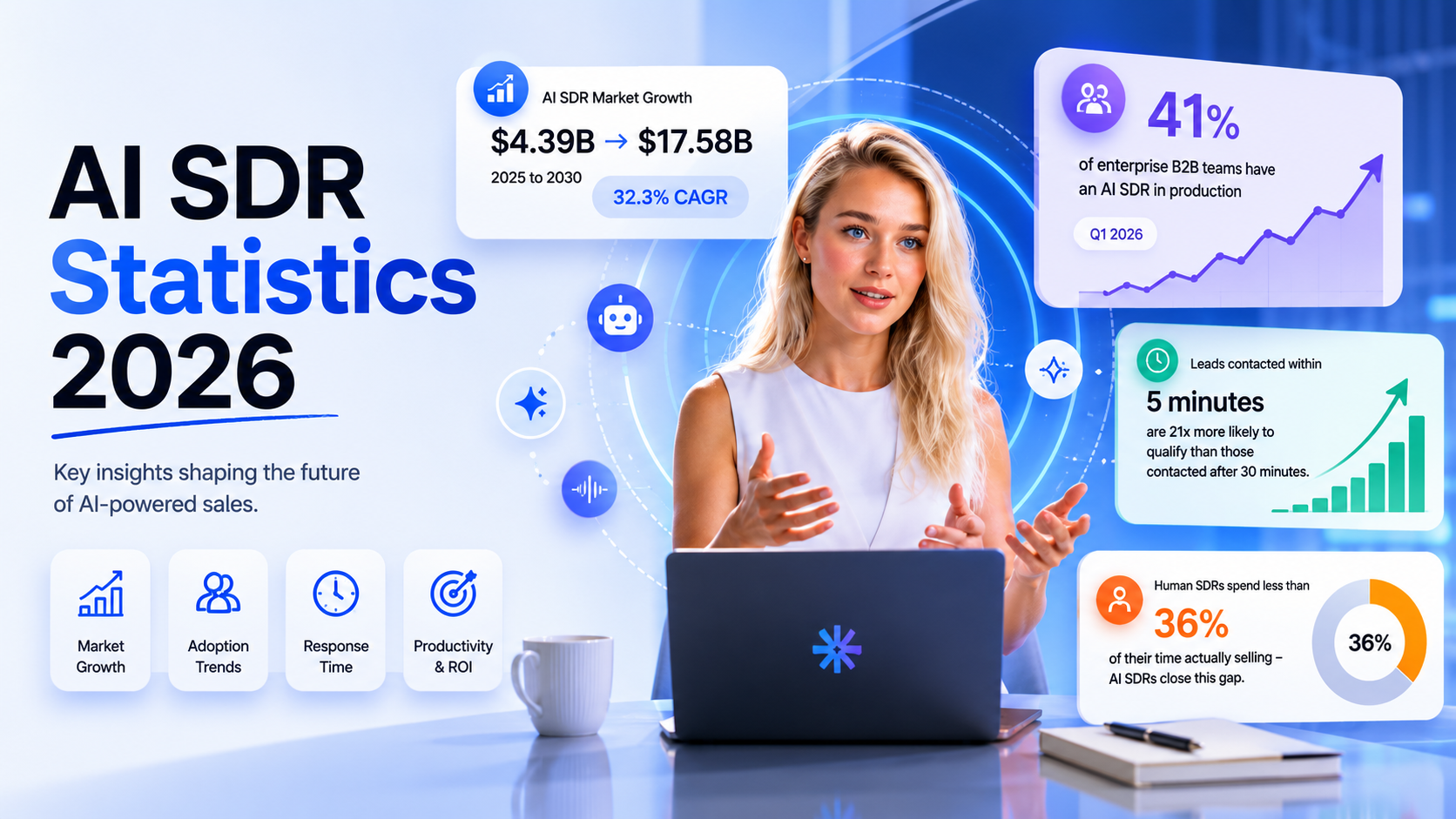
The AI SDR market grows from $4.39B in 2025 to $17.58B by 2030 at a 32.3% CAGR.
41% of enterprise B2B teams have an AI SDR in production as of Q1 2026, up from 12% a year earlier.
Leads contacted within 5 minutes are 21x more likely to qualify than those contacted after 30 minutes.
Human SDRs spend less than 36% of their time actually selling - AI SDRs close this gap.
This page aggregates the most important AI SDR statistics available as of 2026 - covering market growth, adoption rates, lead response time, SDR productivity benchmarks, website conversion data, and ROI proof points. Every statistic includes its original source. This resource is updated quarterly.
AI SDR Market Size and Growth Statistics
How big is the AI SDR market in 2026?
The global AI SDR market was valued at $4.39 billion in 2025 and is projected to reach $5.81 billion in 2026, representing a compound annual growth rate (CAGR) of 32.3%. By 2030, the market is forecast to reach $17.58 billion, sustained at a CAGR of 31.9% through the decade. (Source: The Business Research Company, 2026)
A parallel estimate from GlobeNewswire (2025) places the AI SDR market on track to surpass $15 billion by 2030, driven by demand for personalization at scale and real-time buyer intelligence.
Key market size figures:
Year | AI SDR Market Size | Source |
2025 | $4.39 billion | The Business Research Company |
2026 | $5.81 billion | The Business Research Company |
2030 | $17.58 billion | The Business Research Company |
2030 (alt.) | $15+ billion | GlobeNewswire |
Asia Pacific is the fastest-growing region for AI SDR adoption, driven by rapid B2B SaaS expansion and demand for scalable sales automation at lower per-rep cost. (Source: MarketsandMarkets, 2026)
AI SDR Adoption Rate Statistics
How many companies are using AI SDRs in 2026?
Adoption has accelerated sharply in the past twelve months across every company size segment:
Segment | Q1 2025 Adoption | Q1 2026 Adoption | Change |
Enterprise (500+ employees) | 12% | 41% | +29 pts |
Mid-market | 6% | 27% | +21 pts |
SMB | 2% | 14% | +12 pts |
(Source: devcommx.com AI SDR Statistics Report, 2026)
Additional adoption benchmarks:
63% of sales leaders planned to increase their AI investment in SDR workflows over the following 12 months, as of Q3 2025. (Source: devcommx.com, 2026)
81% of sales teams are either experimenting with or have fully implemented AI in some capacity. Of these, 41% report full implementation. (Source: Salesforce State of Sales, 2024)
55% of companies with 500 or more employees had already adopted AI SDR tools as of Q1 2026. (Source: devcommx.com, 2026)
Conversational AI for inbound qualification is the fastest-growing segment in sales automation in 2026, accounting for 32% of all AI sales deployments. (Source: martal.ca, 2026)
Lead Response Time Statistics
Speed to lead remains the most important conversion variable in B2B sales - and one of AI SDR's clearest advantages.
The average B2B lead response time is 47 hours. (Source: optif.ai, 2025)
Only 23% of B2B companies respond to inbound leads within 5 minutes. (Source: optif.ai, 2025)
42% of B2B companies take longer than 24 hours to respond to a new lead. (Source: optif.ai, 2025)
Leads contacted within 5 minutes are 21x more likely to qualify than those contacted after 30 minutes. (Source: InsideSales.com, via optif.ai, 2025)
Leads responded to in under 5 minutes achieve a 32% close rate - 2.6x higher than leads contacted after 24 hours, which close at 12%. (Source: optif.ai, 2025)
There are 9x more chances of converting a lead if followed up within 5 minutes of their inquiry. (Source: martal.ca, 2026)
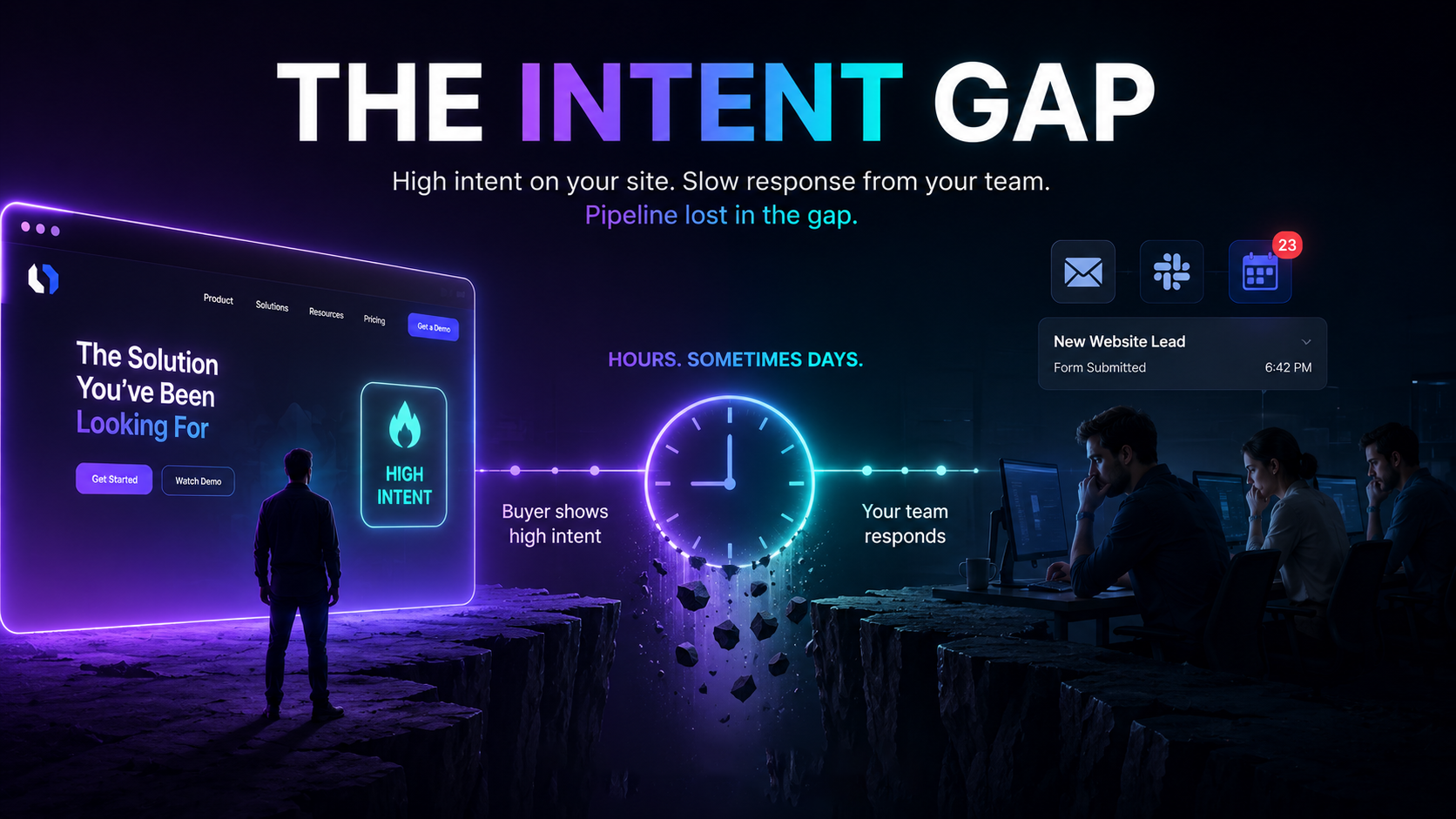
The implication for AI SDRs: A human SDR team responding during business hours cannot serve the 40%+ of B2B web traffic that arrives outside standard working hours. An AI SDR closes this gap entirely - responding in real time, 24/7, regardless of time zone.
SDR Productivity and Performance Statistics
Human SDR benchmarks reveal a structural productivity problem - one that directly motivates AI SDR adoption.
Time Allocation
Human SDRs spend less than 36% of their time actually selling. The remainder is spent on research, list cleaning, CRM entry, and administrative tasks. (Source: salesso.com, 2025)
SDRs using 5 or more tools spend 30–40% of their day context-switching between applications - the top driver of SDR frustration and burnout. (Source: prospeo.io, 2026)
Quota and Performance
Only 57% of SDRs hit quota on average. Among software-focused SDRs, the rate drops to 41.2%. (Source: prospeo.io SDR Benchmarks, 2026)
83% of SDRs miss quota in at least one quarter per year. (Source: prospeo.io, 2026)
Median pipeline generated per SDR: approximately $3 million per year. (Source: prospeo.io SDR Benchmarks, 2026)
Teams using AI SDR tools ramp 30% faster and their reps are 3.7x more likely to hit quota. (Source: devcommx.com, 2026)
Outbound Volume
Average monthly outbound volume per rep: 1,150 activities (human baseline) vs 7,400 activities (AI-augmented mean) - a 6.4x increase. (Source: devcommx.com, 2026)
Tenure and Burnout
Average SDR tenure: 14–18 months. (Source: prospeo.io, 2026)
Average SDR ramp time: 3.2 months. This means the average SDR delivers only ~12.8 months of full productivity before the cycle resets. (Source: prospeo.io, 2026)
Annual SDR turnover rate: 30–39% across the industry. (Source: prospeo.io, 2026)
81% of SDR departures are preventable, driven by burnout, unrealistic quotas, and feeling career-stagnant. (Source: prospeo.io, 2026)
SDR Hiring and Cost Statistics
What does it actually cost to hire and run a human SDR team?
Fully-loaded cost to hire one SDR: $35,000–$55,000, including recruiting ($5–15K), onboarding and training ($10–15K), ramp-down productivity during the first 3 months of the replacement ($10–15K), and team impact ($5–10K). (Source: getshortlistai.com, 2026)
The true cost of losing one SDR - including lost pipeline, team disruption, and replacement costs - can reach $150,000 per departure. (Source: MarketBetter, 2026)
A 90-day ramp on a $60,000 base-salary SDR costs an estimated $15,000 in unproductive salary before that rep generates their first dollar of pipeline. (Source: getshortlistai.com, 2026)
SDR Cost Component | Estimated Range |
Recruiting fees | $5,000–$15,000 |
Onboarding and training | $10,000–$15,000 |
Ramp productivity loss | $10,000–$15,000 |
Team impact (coverage gap) | $5,000–$10,000 |
Tools and software | $5,000–$10,000/year |
Total replacement cost | $35,000–$55,000 |
True cost of one departure | Up to $150,000 |
(Sources: getshortlistai.com, MarketBetter, 2026)
Website Visitor Conversion Statistics
The website conversion gap is the core problem AI SDRs solve for inbound-focused B2B teams.
The average B2B website visitor conversion rate is 1.8%. (Source: First Page Sage, 2026)
For B2B SaaS specifically, the average website-to-lead conversion rate is 1.1% - meaning more than 98 out of every 100 visitors leave without converting. (Source: First Page Sage, 2026)
B2B organic search visitor-to-lead conversion averages 2.7%; paid search averages 1.5%. (Source: martal.ca, 2026)
58% of B2B companies are using chatbot software in some capacity to address the conversion gap. (Source: elevationb2b.com, 2026)
Standard chatbots increase inbound conversions by an average of 28% over no-chat baseline. (Source: landbase.com, 2026)
AI SDR agents, in contrast, can boost website conversion by up to 70% compared to chatbot-only approaches. (Source: Landbase, 2026)
Clara AI SDR delivers 10x more conversations than traditional text chatbots on equivalent traffic volumes. (Source: TruGen.ai customer data, 2026)
AI SDR Performance and ROI Statistics
What results do companies see after deploying AI SDRs?
Organizations using AI for lead scoring report a 35% lift in conversion rates. (Source: Salesforce State of Sales, 2024)
Companies using signal-qualified leads (AI-enriched intent data) report 47% better conversion rates compared to traditional lead scoring. (Source: autobound.ai, 2026)
Meeting booking rates improve by 30–40% when AI is used to optimize messaging, send timing, and channel selection. (Source: devcommx.com, 2026)
AI SDR tools that engage inbound website visitors in real time convert leads at rates 2.6x higher than form-and-wait workflows. (Source: optif.ai, 2025)
Metric | Human SDR Baseline | AI SDR Benchmark | Lift |
Lead response time | 47 hours avg | < 1 minute | 2,800x faster |
Monthly outbound volume | 1,150 activities | 7,400 activities | 6.4x |
Meeting booking rate | Baseline | +30–40% | Significant |
Conversion rate lift | Baseline | +35–70% | Varies by tool |
Quota attainment (AI-augmented teams) | 57% hit quota | 3.7x more likely | Substantial |
After-hours lead coverage | 0% | 100% | Full coverage |
AI SDR Adoption Drivers: Why Companies Are Switching
The data reveals three primary triggers for AI SDR adoption:
1. Coverage gaps: 40% of enterprise B2B web traffic arrives outside standard business hours. (Source: Clearbit, 2024). Human SDRs cannot cover this volume without significant headcount investment.
2. Cost pressure: With fully-loaded SDR costs of $35–55K per hire and replacement costs potentially reaching $150K, AI SDRs offer pipeline coverage at a fraction of the cost.
3. Performance ceiling: At 36% of time spent selling and 57% quota attainment on average, human SDR teams hit a structural ceiling. AI handles repetitive qualification, freeing reps for high-value closing work.
"The moment we saw Clara booking a meeting at 2 AM from a visitor in Singapore - a visitor our SDR team would never have reached - the ROI calculation was instant. That's not a feature. That's recovered revenue." - VP of Sales, B2B SaaS company
Frequently Asked Questions
What is the current size of the AI SDR market in 2026? The AI SDR market is valued at approximately $5.81 billion in 2026, up from $4.39 billion in 2025, according to The Business Research Company. The market is projected to reach $17.58 billion by 2030 at a CAGR of 31.9%.
What percentage of companies use AI SDRs in 2026? As of Q1 2026, 41% of enterprise B2B teams have at least one AI SDR running in production, up from 12% one year earlier. Mid-market adoption stands at 27% and SMB adoption at 14%, according to devcommx.com's 2026 AI SDR statistics report.
How much faster do AI SDRs respond to leads than human SDRs? Human SDR teams average a 47-hour lead response time. AI SDRs respond in under one minute - 24/7, including nights, weekends, and international time zones. Leads contacted within 5 minutes are 21x more likely to qualify than those contacted after 30 minutes (InsideSales.com).
What is the average SDR quota attainment rate? On average, 57% of SDRs hit quota. For software-focused SDRs, the rate drops to 41.2%. Teams that augment SDRs with AI tools see reps become 3.7x more likely to hit quota, according to devcommx.com (2026).
How much does it cost to hire and replace an SDR? The fully-loaded cost to hire one SDR ranges from $35,000–$55,000. The true cost of losing one SDR - including lost pipeline, team disruption, and replacement - can reach $150,000 per departure, according to MarketBetter's 2026 analysis.
What is the average B2B website conversion rate? B2B websites average a 1.8% visitor-to-lead conversion rate overall. For SaaS specifically, the average is 1.1%. This means more than 98% of B2B website visitors leave without converting - the core problem AI SDRs are designed to solve.
Do AI SDRs improve conversion rates? Yes. Organizations using AI for lead scoring report a 35% lift in conversion (Salesforce, 2024). AI SDR agents can boost website conversion by up to 70% over chatbot-only approaches (Landbase, 2026). Signal-qualified leads generated by AI show 47% better conversion than traditional scoring methods (autobound.ai, 2026).
Ready to Put These Numbers to Work?
Clara AI SDR converts the 98%+ of website visitors who currently leave without a conversation - through face-to-face video engagement, live product demos, automatic lead qualification, and real-time meeting booking.
Try Clara Free → - Live on your website in hours. No credit card required.
Related Reading
Clara AI SDR is built by TruGen.ai - the real-time AI video agent platform for B2B revenue teams.