How to Convert Website Visitors into Pipeline: A B2B Playbook for 2026
Most B2B websites convert under 3% of visitors into pipeline. Here's the exact playbook revenue teams are using in 2026 to fix that - with data, tactics, and the tools that actually move the number.
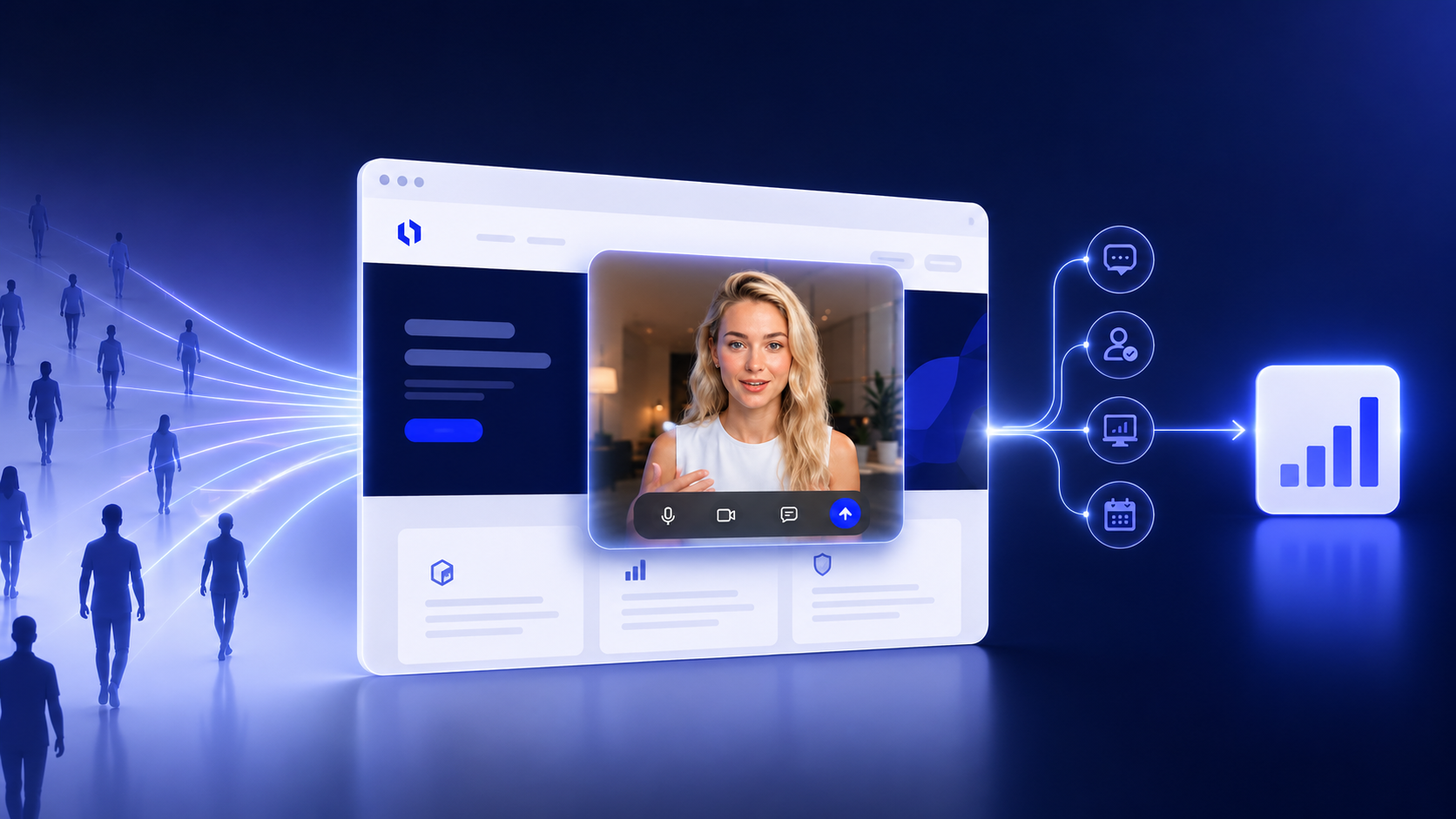
You drove 10,000 visitors to your website last month.
Your SEO is working. Your paid campaigns are running. Your content team published three pieces. And yet - your pipeline barely moved.
This is the defining revenue problem for B2B companies in 2026. According to Marketo research, 97% of B2B website visitors leave without converting into any form of qualified pipeline. Most never return. The demand your marketing created evaporates silently, while budgets keep flowing into acquisition channels that are working - right up until the moment a visitor lands on your site and leaves.
The gap between website traffic and pipeline is not a traffic problem. It is a conversion infrastructure problem. And it is fixable.
This playbook covers exactly how to fix it: why B2B websites fail to convert, the five-step framework revenue teams are using to turn anonymous traffic into booked meetings, and the tools making the biggest measurable difference in 2026.
Why Most B2B Websites Fail to Convert Visitors into Pipeline
The core failure: B2B websites were built to inform, not to convert. They present features, publish case studies, explain pricing, and offer a "Book a Demo" button - then wait for a visitor to take action. Most never do.
Three structural problems explain why:
1. The Response Gap Kills Intent
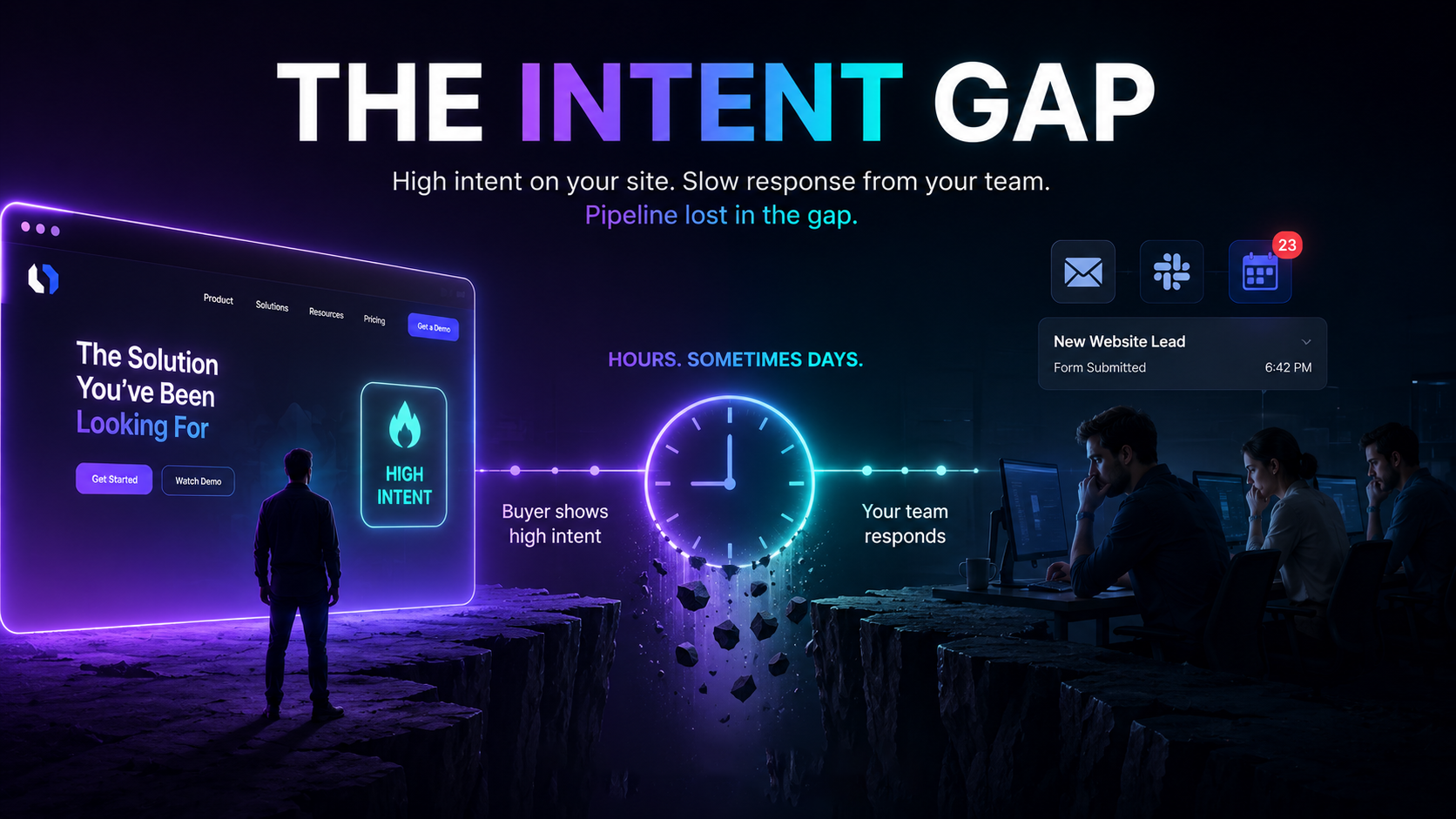
According to Harvard Business Review research, companies that respond to inbound leads within one hour are 7x more likely to qualify that lead than companies waiting two or more hours. The average B2B company takes 42 hours.
The window of peak buyer intent is the website visit itself - the moment when a prospect is on your pricing page, reading your case studies, or comparing you to a competitor. Every minute after they leave, intent decays. By the time a human SDR follows up on a submitted form, most prospects have mentally moved on.
2. Forms Create Friction at the Worst Possible Moment
A "Book a Demo" form asks buyers to do the work. Fill in your name, company, role, team size, use case - all before receiving any value in return. According to Formstack research, 67% of visitors abandon forms when they encounter unexpected questions or length.
Forms are designed around the seller's data collection needs, not the buyer's journey. They signal that the company is not available - only its database is.
3. Text Chatbots Do Not Convert
Average chatbot engagement across B2B websites sits between 2–4% of visitors, per Drift's own published benchmarks. Of those who start a conversation, the majority abandon before reaching any qualification exchange.
Text chatbots fail because they follow scripted flows that break on unexpected questions, cannot demonstrate a platform, and cannot handle real objections. Visitors recognize them instantly as automation - and ignore them at the same rate.
The 5-Step Framework: How to Convert Website Visitors into Pipeline
Step 1: Audit Where Visitors Are Dropping Off
Before adding new tools, map the current state precisely. In your analytics platform, measure:
- Visitor-to-engagement ratio - what percentage of sessions result in any form of interaction (chat, form, demo request)
- Traffic by hour and geography - quantify your after-hours exposure. How much of your traffic arrives outside business hours when no human SDR is available?
- Bounce behavior on high-intent pages - pricing, comparison, and case study pages attract your highest-intent visitors. What is happening on those pages specifically?
Most B2B companies find that 60–80% of their highest-intent traffic leaves completely unengaged. That is the baseline you are working to move.
Step 2: Remove Form-First Friction from High-Intent Pages
The single fastest change most B2B websites can make: stop leading with forms on high-intent pages.
A visitor on your pricing page is ready for a conversation. Your response should be a conversation - not a clipboard. Forms belong after value has been delivered, not before it.
What to change:
- Replace or supplement "Book a Demo" forms on pricing and comparison pages with immediate engagement options
- Move form fields downstream - capture details through conversation, not as the entry condition
- Ensure high-intent pages have an active engagement mechanism, not just passive content
Step 3: Establish Real-Time Engagement During the Visit
The visit itself is the conversion window. Any mechanism that requires visitors to take action first - click a chat button, submit a form, schedule a call - is adding friction at the moment of peak intent.
The principle: engage visitors during the visit, not after it.
Real-time engagement means a conversation starts when a visitor lands on a high-intent page - not when they choose to initiate one. This is the architectural shift that separates companies converting 1–2% of traffic from companies converting 8–12%.
Step 4: Deploy an AI SDR That Qualifies and Demonstrates on the Spot
This is where the measurable gap opens between companies that have moved beyond chatbots and those still running text widgets.
Clara AI SDR is already running on B2B websites - converting visitors that used to bounce. Clara engages visitors face to face through a lifelike AI presence, not a text chat bubble. In a single conversation, Clara:
- Greets visitors the moment they land on a high-intent page
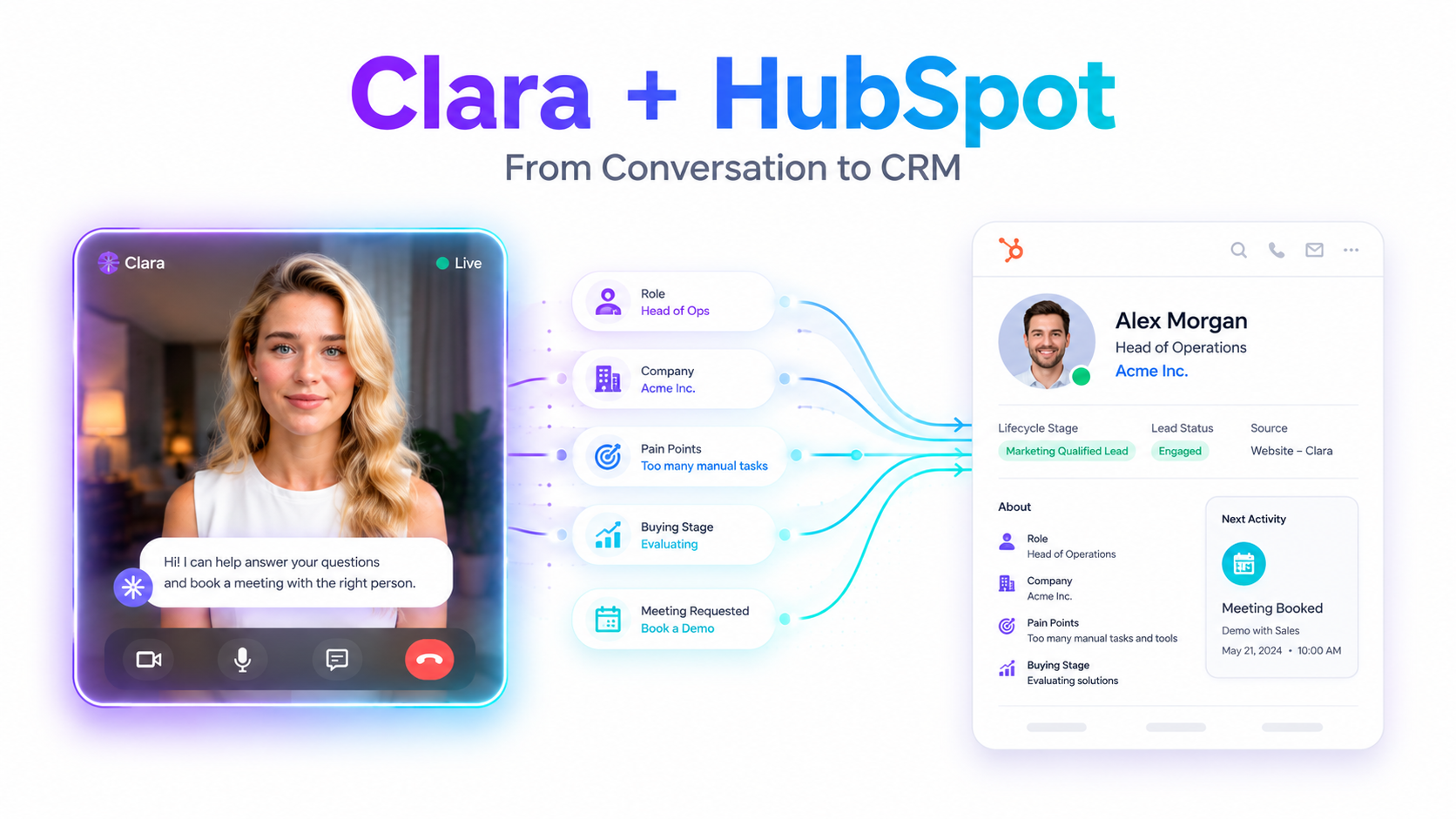
- Qualifies them through natural conversation - capturing role, company, pain point, and buying timeline without a form
- Demonstrates the platform by sharing her screen to present decks, ROI models, and architecture diagrams mid-conversation
- Handles objections by opening a live browser to navigate pricing pages, integration documentation, and competitor comparisons in real time
- Books meetings directly into the sales team's calendar, with full conversation context passed to the CRM
What the numbers show: A B2B SaaS company, deployed Clara on their website and recorded a +19% increase in visitor-to-pipeline conversion and +40% improvement in customer retention within the first quarter. The pipeline did not grow because traffic increased. It grew because the conversion infrastructure changed.
The face-to-face engagement model is what drives this difference. Research shows face-to-face interaction generates 44% higher user retention compared to text or voice-only alternatives. Visitors who experience a genuine conversation - not a scripted text exchange - stay longer, share more qualification data, and convert to meetings at a dramatically higher percentage.
Step 5: Ensure 24/7 Coverage Across Every Time Zone
Map your traffic by hour and geography. Then map your SDR team's working hours. The gap between those two is your pipeline leak.
According to Salesforce research, 40% of B2B research and purchase decisions happen outside standard business hours - evenings, weekends, and across global time zones.
A prospect in Singapore evaluating your platform at 9 PM their time has zero engagement options at most B2B companies. By the time a human follows up Tuesday morning, that prospect is two conversations deep with a competitor.
Clara operates 24/7, engaging every visitor in every time zone, every weekend, every holiday. No leads lost to availability gaps. No after-hours traffic that simply bounces. Already booking meetings while your team is offline.
The Pipeline Math: What Moving Conversion Numbers Actually Means
Apply real numbers to understand the opportunity.
Assume 5,000 monthly website visitors and a current visitor-to-meeting conversion percentage of 1% - which is above average for most B2B websites. That is 50 booked meetings per month from 5,000 opportunities.
Moving that conversion percentage to 5% - still well below what face-to-face AI engagement achieves - produces 250 meetings per month from the same traffic.
With an average deal value of $25,000 and a 20% close percentage on qualified meetings:
- Before: 50 meetings × 20% × $25,000 = $250,000/month pipeline
- After: 250 meetings × 20% × $25,000 = $1,250,000/month pipeline
The traffic budget did not change. The ad spend did not increase. The conversion infrastructure changed.
How to Measure Visitor-to-Pipeline Conversion
Replace traffic volume as a primary metric with these four measurements:
|
Metric |
What It Measures |
Target |
|
Visitor-to-conversation percentage |
What share of sessions result in any active engagement |
Above 5% on high-intent pages |
|
Conversation-to-meeting percentage |
What share of conversations result in a booked meeting |
Above 30% for qualified AI SDR conversations |
|
Pipeline per 1,000 visitors |
Combines both ratios into one revenue-connected number |
Track weekly, optimize monthly |
|
After-hours coverage percentage |
What share of traffic occurs outside SDR availability hours |
Quantifies the gap Clara closes |
Frequently Asked Questions
How do I convert more website visitors into pipeline?
Converting website visitors into B2B pipeline requires three changes: removing form-first friction from high-intent pages, deploying real-time engagement during the visit rather than after it, and ensuring 24/7 coverage so after-hours traffic does not bounce unengaged. The highest-impact single change is replacing passive text chatbots with face-to-face AI engagement - companies doing this are recording 5–10x improvements in visitor-to-pipeline conversion compared to chatbot baselines.
What is a good B2B website conversion percentage in 2026?
Most B2B websites convert between 1–3% of visitors into any form of pipeline. Companies with active real-time engagement - particularly face-to-face AI SDR deployment on high-intent pages - are achieving 8–12% visitor-to-conversation percentages on those pages. The average across all traffic is lower, but high-intent pages (pricing, comparison, case studies) should be measured separately as conversion targets.
Why are my website visitors not converting into leads?
The most common reasons B2B website visitors do not convert: forms add friction at the moment of peak intent; there is no real-time engagement mechanism during the visit; chatbots are ignored because visitors recognize scripted text automation; and after-hours traffic has no engagement option. Visitors with genuine buying intent will not wait 42 hours for a response - they move on. Fixing this requires engagement during the visit, not a better follow-up sequence after it.
How does an AI SDR improve website conversion?
An AI SDR improves website conversion by engaging every visitor immediately - regardless of time zone, day of week, or SDR availability - through natural conversation rather than forms or chatbots. Advanced AI SDRs like Clara engage face to face through a lifelike video presence, demonstrate the platform live via screen share, handle objections by navigating real pages in the browser, and book meetings automatically. Syntechsoft recorded a +19% lift in visitor-to-pipeline conversion after deploying Clara, compared to their previous chatbot setup.
What is the difference between website traffic and pipeline?
Website traffic measures how many people visit your site. Pipeline measures how many of those visitors have been qualified and are actively moving toward a purchase. The gap between the two - typically 97% of visitors - represents buyers who had some level of intent but left without entering your revenue process. Converting traffic into pipeline requires active engagement during the visit: qualification through conversation, demonstration of the platform, and meeting booking before the visitor leaves.
How do I increase B2B website conversion without increasing ad spend?
Increasing B2B website conversion without increasing ad spend means converting a higher percentage of the traffic you already have. The primary levers: removing friction (forms, scheduling delays), deploying real-time engagement (AI SDR on high-intent pages), and ensuring 24/7 availability. Clara AI SDR starts at $0 and is live on your website within hours - the investment is in conversion infrastructure, not additional acquisition budget.
The Bottom Line
Your website is already receiving the traffic. The visitors exist. The intent exists. The pipeline is not appearing because the conversion infrastructure between traffic and meetings is passive - it describes your platform, waits for visitors to act, and loses 97% of them before any conversation starts.
The companies pulling ahead in 2026 are the ones who changed the infrastructure. Face-to-face AI engagement, 24/7 availability, real-time demonstration, and automatic meeting booking - the full SDR motion, automated, running for every visitor on every page, around the clock.
Clara is already converting visitors like yours into pipeline for 100+ B2B companies. Starting at $0, live in hours.
Start converting your traffic today →