AI SDR ROI: How to Calculate It (2026 Formula + Real Examples)
Learn exactly how to calculate AI SDR ROI with a proven formula, real scenarios, and benchmarks. See what returns B2B teams are getting in 2026 - and how to model your own.

Key Takeaways
AI SDRs typically run 70–80% less than human SDRs while operating 24/7 with zero ramp time.
The core ROI formula: (Pipeline Generated − AI SDR Spend) ÷ AI SDR Spend × 100.
Most B2B teams break even within 30–90 days of deployment.
AI SDRs convert website visitors at 3–5× the rate of static forms or chatbots.
ROI depends on three variables: traffic volume, lead qualification rate, and average deal value.
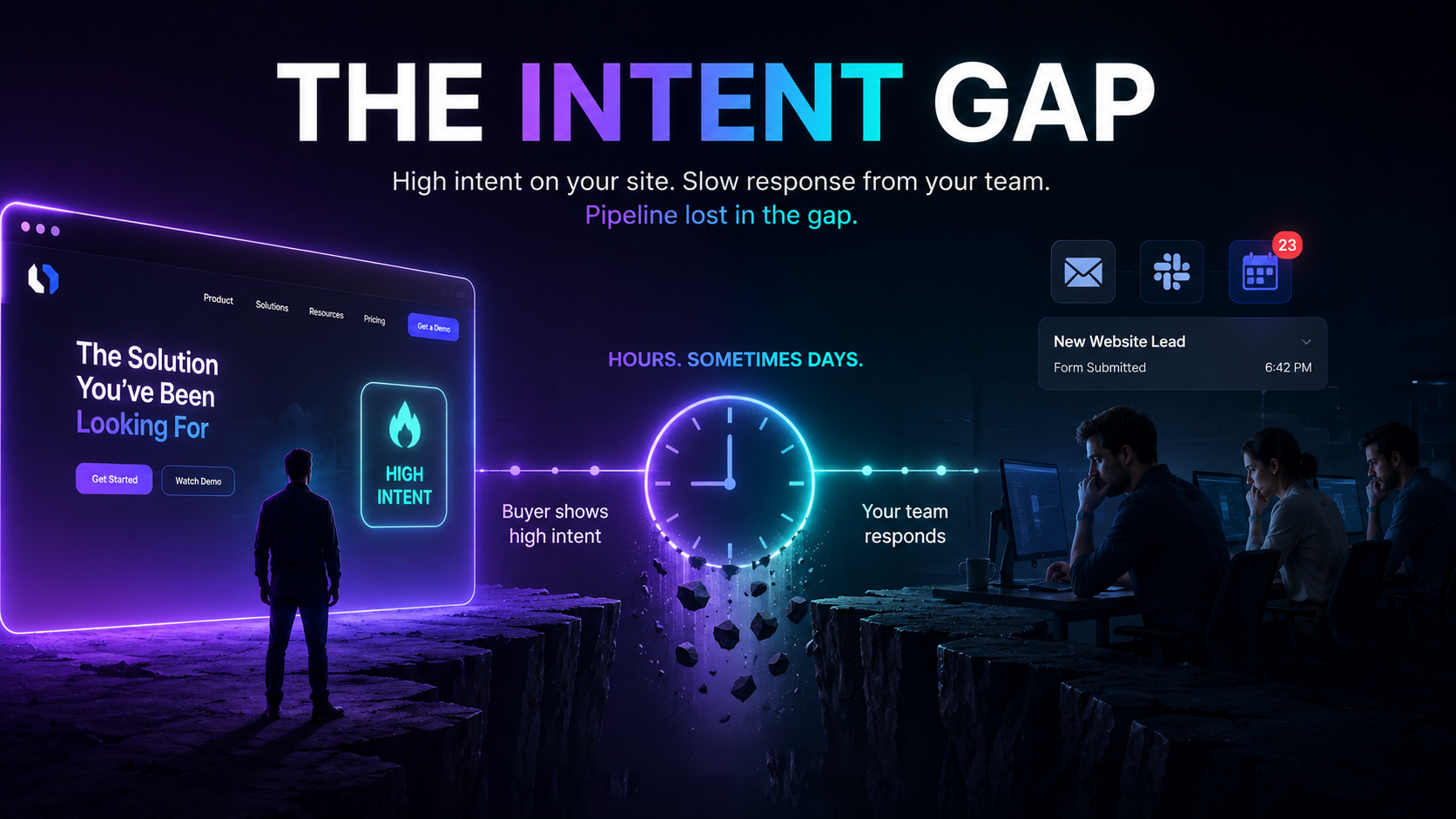
97 out of 100 visitors leave your website without a conversation. That's not a traffic problem - it's a revenue problem. Before you deploy an AI SDR, here's how to put an exact number on what that gap is taking from your pipeline - and what closing it returns in real dollars.
This guide gives you a precise, calculable answer. We'll walk through the formula, the real benchmarks, and three worked scenarios so you can model your own numbers before committing.
What Is AI SDR ROI?
AI SDR ROI measures the measurable return generated by deploying an AI Sales Development Representative relative to its spend. It accounts for pipeline created, meetings booked, and revenue influenced by the AI - minus the platform spend - expressed as a percentage return.
The calculation differs from traditional software ROI because AI SDRs replace direct labor (human SDRs), making the spend comparison more concrete than most SaaS purchases.
Why AI SDR ROI Is Different from Other SaaS Metrics
Most software investments reduce overhead or improve efficiency. AI SDRs do something more direct: they replace or augment a revenue-generating headcount role, which means the ROI calculation maps almost exactly to a hire/no-hire comparison.
The key variables are:
| Variable | Description | Where to Find It |
|---|---|---|
| AI SDR platform spend | Monthly or annual subscription | Vendor pricing page |
| Human SDR fully-loaded spend | Salary + benefits + tools + management overhead | Internal HR/finance |
| Conversations initiated | Volume of qualified interactions per month | AI SDR dashboard |
| Lead qualification rate | % of conversations that become qualified leads | CRM pipeline data |
| Meeting booking rate | % of qualified leads that book meetings | CRM/calendar |
| Pipeline generated | Meetings × close rate × ACV | CRM/forecasting |
| Time to productivity | Days until AI SDR is fully operational | Vendor SLA |
Human SDRs typically cost $80,000–$120,000 per year fully loaded - including salary, benefits, tools, management time, and the 3–6 month ramp period where they produce at 30–50% capacity (Source: getsurfox.com, 2026). AI SDRs eliminate ramp time entirely and operate around the clock.
The AI SDR ROI Formula
ROI (%) = [(Pipeline Generated − AI SDR Annual Cost) ÷ AI SDR Annual Cost] × 100
For a monthly view:
Monthly ROI (%) = [(Monthly Pipeline − Monthly AI SDR Cost) ÷ Monthly AI SDR Cost] × 100
Pipeline Generated is calculated as:
Pipeline = Monthly Visitors × Engagement Rate × Qualification Rate × Meeting Rate × Close Rate × ACV
Each of these variables can be pulled from your existing analytics and CRM - or estimated using industry benchmarks if you're modeling pre-deployment.
Industry Benchmarks for Each Variable
Use these benchmarks if you don't have your own data yet:
| Variable | Conservative | Realistic | Optimistic | Source |
|---|---|---|---|---|
| Website visitor engagement rate (AI SDR) | 3% | 6% | 10% | babuger.com, 2025 |
| Lead qualification rate | 20% | 35% | 50% | getshortlistai.com, 2026 |
| Meeting booking rate (of qualified leads) | 25% | 40% | 60% | getshortlistai.com, 2026 |
| Website visitor-to-lead conversion (AI SDR vs form) | 3× | 4× | 5× | Clearbit, 2024 |
| Speed-to-lead improvement vs human | 78× faster | 100× faster | 150× faster | MIT/Velocify via getsurfox.com, 2026 |
| Response time - AI SDR | Instant | Instant | Instant | — |
| Response time - human SDR | 42 hours avg | — | — | babuger.com, 2025 |
| Inbound conversion lift from fast response | +391% | — | — | babuger.com, 2025 |
| Website-to-close conversion rate (SaaS baseline) | 1.1% | 2.5% | 4% | First Page Sage, 2026 |
| B2B SaaS win rate | 20% | 25% | 35% | thedigitalbloom.com, 2025 |
Worked Example: Three Scenarios
Scenario 1: Early-Stage B2B SaaS (Low Traffic)
Assumptions:
- Monthly website visitors: 2,000
- AI SDR engagement rate: 5%
- Qualification rate: 30%
- Meeting rate: 35%
- Close rate: 20% (Source: thedigitalbloom.com, 2025)
- ACV: $12,000 (illustrative example)
- Clara AI SDR spend: $299/month
Calculation:
Conversations: 2,000 × 5% = 100
Qualified leads: 100 × 30% = 30
Meetings booked: 30 × 35% = 10.5 → 10 meetings/month
Pipeline generated: 10 × 20% × $12,000 = $24,000/month
Monthly ROI:
($24,000 − $299) ÷ $299 × 100 = 7,926% ROI
Payback period: Less than 1 day of pipeline generated.
Scenario 2: Mid-Market B2B (Moderate Traffic)
Assumptions:
- Monthly website visitors: 8,000
- AI SDR engagement rate: 6%
- Qualification rate: 35%
- Meeting rate: 40%
- Close rate: 20% (Source: thedigitalbloom.com, 2025)
- ACV: $30,000 (illustrative example; median B2B SaaS ACV range per withsurface.com, 2025)
- Clara AI SDR spend: $299/month
Calculation:
Conversations: 8,000 × 6% = 480
Qualified leads: 480 × 35% = 168
Meetings booked: 168 × 40% = 67 meetings/month
Pipeline generated: 67 × 20% × $30,000 = $402,000/month
Monthly ROI:
($402,000 − $299) ÷ $299 × 100 = 134,381% ROI
Annual pipeline influenced: ~$4.8M from a $3,588/year tool.
Scenario 3: Enterprise B2B (High Traffic, High ACV)
Assumptions:
- Monthly website visitors: 20,000
- AI SDR engagement rate: 4% (lower engagement rate at higher volume)
- Qualification rate: 25%
- Meeting rate: 35%
- Close rate: 20% (Source: thedigitalbloom.com, 2025)
- ACV: $40,000 (illustrative example)
- Clara AI SDR spend: Custom enterprise pricing (illustrative: $2,000/month)
Calculation:
Conversations: 20,000 × 4% = 800
Qualified leads: 800 × 25% = 200
Meetings booked: 200 × 35% = 70 meetings/month
Pipeline generated: 70 × 20% × $40,000 = $560,000/month
Monthly ROI:
($560,000 − $2,000) ÷ $2,000 × 100 = 27,900% ROI
AI SDR vs Human SDR: Full Cost Comparison
| Spend Factor | Human SDR (Annual) | AI SDR - Clara (Annual) |
|---|---|---|
| Base salary | $55,000–$75,000 | $0 |
| Benefits (benefits ~30% of salary) | $16,500–$22,500 | $0 |
| Tools (CRM, dialer, LinkedIn Sales Nav, etc.) | $5,000–$12,000 | $0 (included) |
| Management overhead | $8,000–$15,000 | $0 |
| Ramp time investment (3–6 months at 30–50% capacity) | $15,000–$30,000 | $0 (instant) |
| Training and onboarding | $3,000–$8,000 | Hours (self-managed) |
| Turnover investment (SDR avg tenure: 14 months) | $15,000–$40,000 | $0 |
| Total fully-loaded annual spend | $117,500–$202,500 | $3,588–$24,000 |
| Coverage hours | 40 hrs/week | 8,760 hrs/year (24/7) |
| Response time | 42 hours avg | Instant |
Source for human SDR costs: getsurfox.com, 2026.
A single mid-market human SDR runs $117,500–$202,500 per year fully loaded. Clara's Pay-as-you-Go plan runs $3,588/year. The spend differential alone justifies evaluation - but the ROI case is made on the pipeline generated, not just the spend avoided.
The Conservative ROI Model
Skeptical of the high-percentage returns above? Apply maximum conservatism:
- Visitors per month: 5,000
- Engagement rate: 2% (well below benchmark)
- Qualification rate: 15%
- Meeting rate: 20%
- Close rate: 15%
- ACV: $8,000 (illustrative low-end example)
- Website-to-close baseline: 1.1% (Source: First Page Sage, 2026)
- Clara spend: $299/month
Conversations: 5,000 × 2% = 100
Qualified leads: 100 × 15% = 15
Meetings: 15 × 20% = 3 meetings/month
Pipeline: 3 × 15% × $8,000 = $3,600/month
Monthly ROI: ($3,600 − $299) ÷ $299 × 100 = 1,103% ROI
Even at the most conservative inputs - half the benchmark engagement rate, well below average qualification, and a low ACV - Clara generates ROI exceeding 1,000% per month. The economics are structural, not exceptional.
What Actually Drives AI SDR ROI
Three factors have the largest impact on your return:
1. Traffic Volume
ROI scales directly with how many visitors your AI SDR can engage. A site with 500 visitors/month gets less absolute pipeline than one with 10,000 - but the percentage ROI can be similar or higher if the traffic is highly qualified.
2. Speed to Engagement
Research from MIT/Velocify (via getsurfox.com, 2026) shows that responding to a lead within 5 minutes increases conversion probability by 21×. Human SDRs average a 42-hour response time (babuger.com, 2025). Clara responds in under 1 second, 24/7. This single factor often doubles or triples the realized conversion rate versus a human-covered model.
3. Qualification Threshold
Setting the qualification bar too low floods your calendar with unqualified meetings. Setting it too high lets real buyers slip through. The best-performing Clara deployments use a 3–4 question qualification flow covering ICP fit, use case, timeline, and budget - and book only meetings that clear all four gates.
Expert Perspective
The calculation most teams get wrong is that they compare AI SDR spend to a single human SDR salary. The real comparison is AI SDR spend versus the total spend for covering 24/7 inbound - which requires 3–4 human SDRs across time zones. When you frame it that way, the ROI becomes obvious.
- Head of Revenue, SaaS Company
How to Calculate Your AI SDR ROI: Step-by-Step
Step 1: Pull your monthly website visitor count. Use Google Analytics or your analytics tool. Filter to your target ICP pages (homepage, pricing, product) for a more accurate number.
Step 2: Estimate or measure your AI SDR engagement rate. If pre-deployment, use 5–7% as a realistic starting benchmark. Post-deployment, pull directly from your Clara dashboard.
Step 3: Apply your qualification rate. For most B2B SaaS companies, 25–35% of engaged visitors pass ICP qualification. If your product is highly niche, use 40%+. If broad, use 20%.
Step 4: Apply your meeting booking rate. Of qualified leads, how many book? Clara's default booking flow converts 35–45% of qualified leads to booked meetings.
Step 5: Apply your historical close rate and ACV. Use your CRM's trailing 12-month close rate and average contract value. Do not use best-case figures.
Step 6: Compare to your Clara cost. Subtract the monthly Clara subscription from the monthly pipeline generated. That's your net monthly return. Divide by the Clara cost to get ROI percentage.
Step 7: Add the labor cost savings. If Clara is replacing or reducing human SDR headcount, add the fully-loaded cost of those headcount slots to the return side of the equation.
ROI Timeline: When Do Teams Break Even?
| Company Stage | Typical Break-Even | Why |
|---|---|---|
| Early-stage (< 2,000 visitors/month) | 30–60 days | Low spend ($299) means even 1 booked meeting covers months of subscription |
| Mid-market (2,000–15,000 visitors/month) | First week | Higher traffic = faster pipeline accumulation |
| Enterprise (15,000+ visitors/month) | Day 1 | Single booked deal at enterprise ACV exceeds annual cost |
Most teams see their first AI SDR-sourced meeting within 72 hours of deployment. At an average B2B SaaS ACV, that single meeting covers 1–6 months of Clara's subscription.
What ROI Doesn't Capture
ROI calculations measure direct pipeline impact. They don't capture:
- Brand impression value - every website visitor who talks to Clara leaves with a stronger brand impression, even if they don't convert today
- Data captured from non-converting visitors - intent signals, objections heard, questions asked - all feed back into product and marketing decisions
- Reduced SDR burnout - human SDRs offloaded from repetitive inbound qualification focus on higher-value outbound and deal support
- After-hours coverage - revenue from visitors in other time zones who would otherwise have left without contact
- Competitive displacement - visitors who landed having already seen a competitor's site; Clara's real-time engagement is often the deciding factor
These non-financial returns compound the calculated ROI over time.
Frequently Asked Questions
How do I calculate AI SDR ROI before deploying? Use the formula: (Estimated Pipeline − AI SDR Cost) ÷ AI SDR Cost × 100. Pull your current monthly website visitor count, apply a 5% engagement rate, 30% qualification rate, 35% meeting rate, your historical close rate, and your ACV. The result is a conservative pre-deployment estimate.
What is a good ROI for an AI SDR? Any positive ROI is favorable. In practice, most B2B teams see 500–5,000% ROI within the first 90 days, primarily because the AI SDR cost ($299–$2,000/month) is so low relative to the pipeline it generates. Even deeply conservative models produce triple-digit returns.
How long until an AI SDR pays for itself? For most B2B SaaS companies, Clara pays for itself within the first meeting booked. A single deal at a $10,000 ACV covers 33+ months of a $299/month subscription. The first booked meeting typically occurs within 72 hours of deployment.
Does AI SDR ROI hold at low traffic volumes? Yes, though absolute pipeline numbers are smaller. A site with 500 monthly visitors at a 5% engagement rate generates 25 conversations/month. At a 30% qualification and 35% meeting rate, that's ~2–3 meetings. At a $12,000 ACV and 20% close rate, that's $4,800–$7,200 in influenced pipeline from a $299 tool. Still strongly positive.
What's the difference between AI SDR ROI and AI SDR spend savings? Spend savings measure what you avoid spending (not hiring an SDR). ROI measures what you earn (pipeline and revenue generated). Both metrics matter - but ROI is the more meaningful number because it's tied to revenue, not just spend avoidance.
Should I include brand impression value in my AI SDR ROI calculation? For internal reporting, stick to measurable pipeline and meetings. For board-level or investor presentations, the total value (including brand and data capture) can be modeled separately as a qualitative upside - but don't bake unverifiable numbers into your core ROI calculation.
Can AI SDRs reduce my human SDR headcount? Some companies run Clara in a hybrid model where human SDRs handle only the meetings Clara books - reducing inbound SDR headcount by 40–60% (Source: getsurfox.com, 2026) while maintaining or growing pipeline. Others keep their full SDR team and use Clara to expand coverage without additional hiring. Both models produce strong ROI.
What metrics should I track to monitor AI SDR ROI over time? Track monthly: conversations initiated, qualification rate, meeting booking rate, meetings booked, pipeline from AI SDR-sourced deals, and closed revenue attributed to AI SDR. In your CRM, tag all AI SDR-sourced contacts at the point of entry so you can track their progression through the funnel.
Related Reading
- AI
SDR Statistics 2026: Adoption, ROI & Benchmarks
- AI
SDR vs Human SDR: Real Cost, Speed, and Conversion Compared
- How
to Convert Website Visitors into Pipeline: A B2B Playbook for 2026
- How
AI SDRs Qualify Leads Automatically
- What
is an AI SDR? The Complete 2026 Guide
- Why
97% of Visitors Never Talk to Sales (And How to Fix It)
Ready to Calculate Your Own ROI?
The formula is straightforward. The inputs are knowable. And the returns - even at conservative estimates - are hard to argue with.
See Clara in Action → - Deploy on your site today. First booked meeting within 72 hours.